Wedge Patterns: Rising and Falling Setups Explained
What Wedge Patterns Are
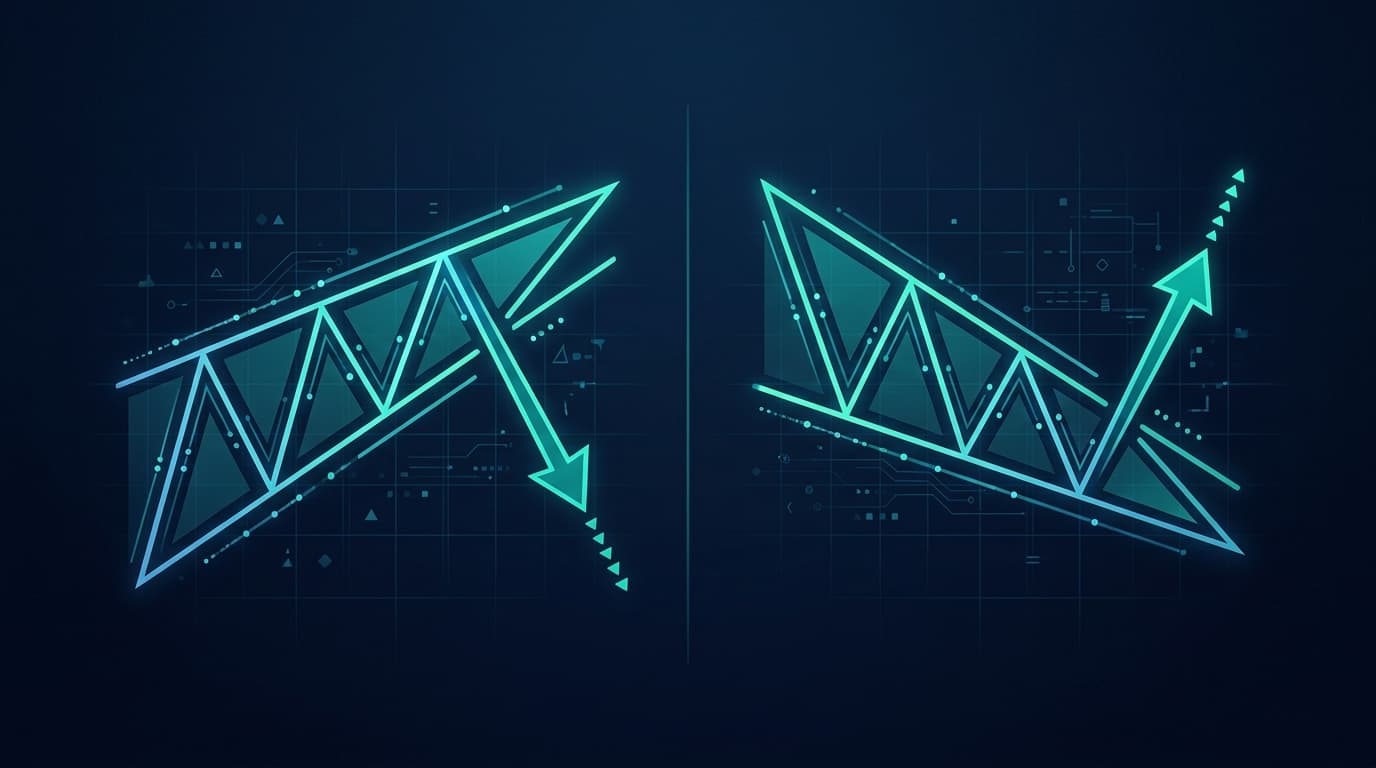
A wedge pattern forms when price action contracts between two converging trend lines that both slope in the same direction. This is the defining characteristic that separates wedges from triangles. In a triangle, the trend lines either converge from opposite directions (symmetrical triangle), or one line is flat while the other slopes toward it (ascending or descending triangle). In a wedge, both trend lines slope upward or both slope downward, creating a narrowing channel with a directional tilt.
Wedges represent a temporary imbalance between buyers and sellers that is gradually resolving. The narrowing range shows that the dominant side (whichever direction the wedge slopes) is losing momentum. The price is still moving in one direction, but the moves are getting smaller. Eventually, the weakening side collapses and the price breaks in the opposite direction of the wedge's slope.
There are two types of wedge patterns: rising wedges (typically bearish) and falling wedges (typically bullish). Both follow the same structural logic but produce opposite outcomes.
Rising Wedge: Bearish Despite Upward Slope
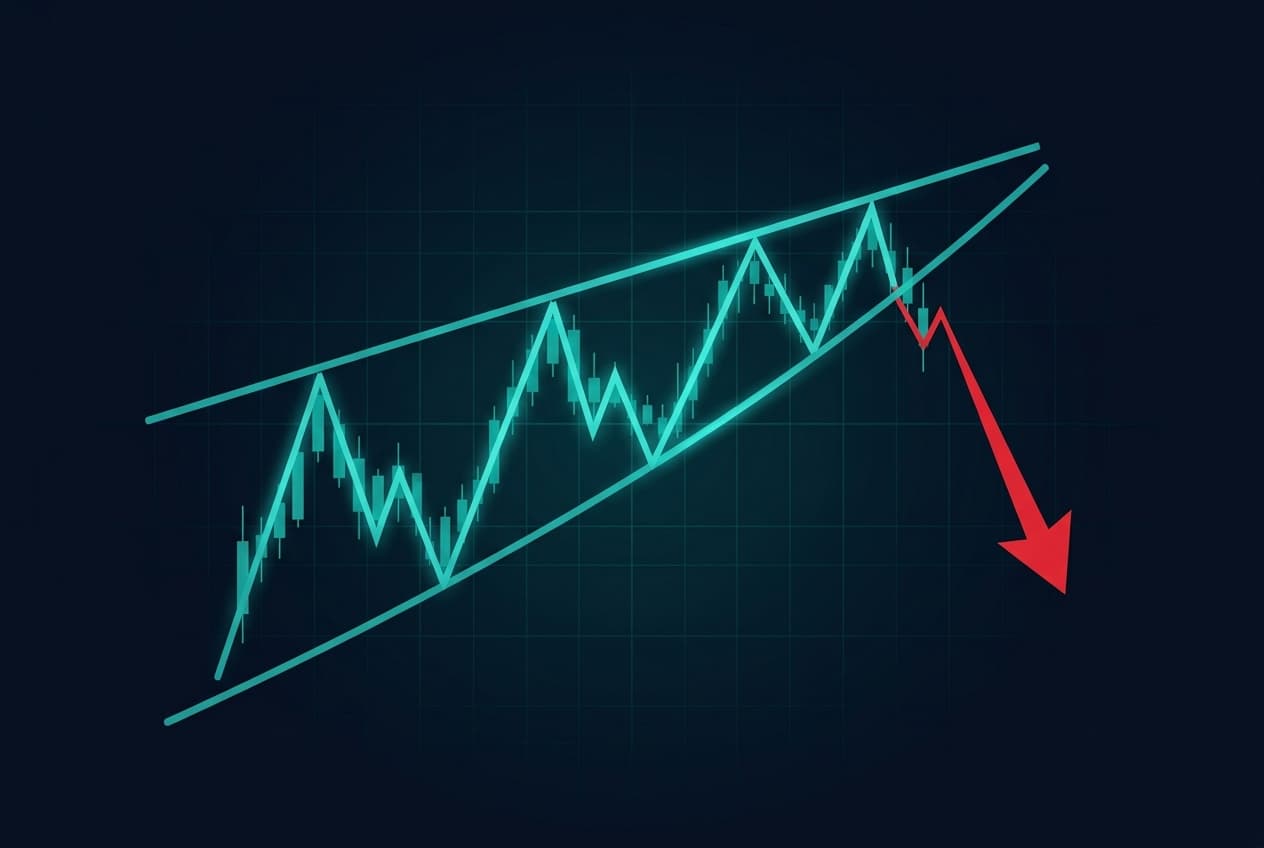
A rising wedge forms when price makes higher highs and higher lows, but the highs are rising at a slower rate than the lows. Both trend lines slope upward, but the lower trend line is steeper than the upper trend line, causing the two lines to converge.
Structure: Draw a trend line connecting two or more higher highs (the upper boundary). Draw a second trend line connecting two or more higher lows (the lower boundary). Both lines slope upward, but the lower line rises more steeply, so the distance between them narrows over time. The pattern needs at least four touch points total (two on each line) to be valid. Five or more touches increase reliability.
Why it is bearish: The rising wedge tells a specific story about buyer exhaustion. Buyers are still pushing the price up, but each rally covers less ground than the previous one. Meanwhile, sellers are becoming more aggressive at each pullback, refusing to let the price drop as far before stepping in. This sounds bullish (higher lows), but the shrinking range of the rallies reveals that buying pressure is fading. Sellers are tightening the noose.
Consider a stock rising from $40 in a wedge pattern. The first rally reaches $46 (a $6 gain). The pullback drops to $42. The second rally reaches $48 (only a $2 gain from the prior high, vs $6 initially). The pullback drops to $44. The third rally reaches $49 (only a $1 gain). Each push higher is weaker than the last. The buyers are running out of conviction. When they finally fail to push higher at all, the accumulated selling pressure breaks the lower trend line and the price drops.
Where rising wedges appear: Rising wedges form in two contexts. As a reversal pattern, they appear at the end of uptrends. The final push higher occurs within the wedge, and the breakdown signals the beginning of a downtrend. As a continuation pattern, they appear within downtrends as a counter-trend rally. The price bounces upward in a rising wedge before resuming the dominant downward trend.
The context of the prior trend matters for setting expectations. A rising wedge after a long uptrend may signal a major reversal. A rising wedge within a downtrend is a bearish continuation and the subsequent drop often reaches or exceeds the low that preceded the wedge.
Falling Wedge: Bullish Despite Downward Slope
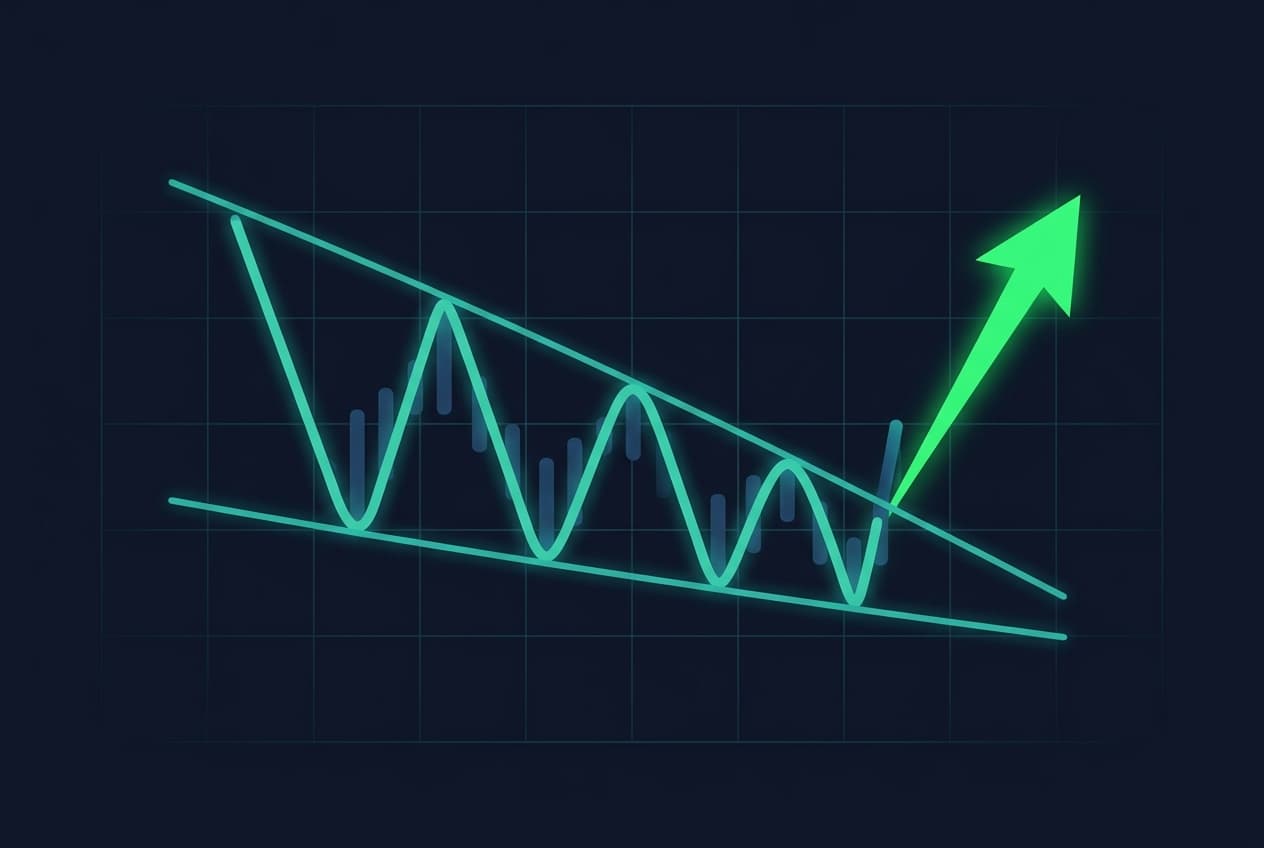
A falling wedge forms when price makes lower highs and lower lows, but the lows are falling at a slower rate than the highs. Both trend lines slope downward, but the upper trend line is steeper than the lower trend line, causing convergence.
Structure: Draw a trend line connecting two or more lower highs (the upper boundary). Draw a second trend line connecting two or more lower lows (the lower boundary). Both lines slope downward, but the upper line descends more steeply, so the distance narrows over time. As with rising wedges, four or more touch points are needed.
Why it is bullish: The falling wedge reveals seller exhaustion. Sellers are still pushing price down, but each decline covers less ground. Buyers are becoming more aggressive at each rally attempt, capping the downside more quickly each time. The shrinking range of the declines shows that selling pressure is fading.
Consider a stock falling from $80 in a wedge pattern. The first decline drops to $70 (a $10 drop). The rally pushes to $76. The second decline reaches $68 (only a $2 drop from the prior low). The rally reaches $73. The third decline reaches $67 (only a $1 drop). Sellers are losing steam. When they can no longer push to new lows, buyers overwhelm them and the price breaks above the upper trend line.
Where falling wedges appear: As a reversal pattern, falling wedges form at the end of downtrends. The final decline occurs within the wedge, and the breakout signals the beginning of an uptrend. As a continuation pattern, they appear within uptrends as a pullback. The price dips into a falling wedge before resuming the uptrend.
How Wedges Differ from Triangles
This is one of the most common points of confusion in technical analysis. The table below clarifies the structural differences.
| Feature | Wedge | Triangle |
|---|---|---|
| Trend line direction | Both slope the same way (both up or both down) | Lines converge from different angles, or one is flat |
| Directional bias | Opposite to the wedge's slope | Depends on type (ascending = bullish, descending = bearish, symmetrical = neutral) |
| Breakout direction | Against the wedge's slope (rising wedge breaks down, falling wedge breaks up) | Ascending breaks up, descending breaks down, symmetrical can go either way |
| Slope requirement | Both lines must slope in the same direction | No slope requirement for the flat line in ascending/descending |
| Typical duration | Often longer than triangles | Varies |
The simplest test: look at your two converging trend lines. If both lines slope upward or both slope downward, you have a wedge. If one line is flat, or if the lines slope toward each other from opposite directions, you have a triangle.
Another difference is reliability. Wedges have a built-in directional bias (the breakout opposes the slope), while symmetrical triangles are neutral. This makes wedges somewhat easier to trade because you have a predetermined expectation for the breakout direction.
Volume Characteristics During Wedge Formation
Volume behavior in wedges follows a predictable pattern that confirms the formation's validity.
During formation: Volume should decline steadily as the wedge develops. This declining volume reflects the shrinking price range and diminishing participation. If volume is increasing during the wedge formation, the pattern may not be a true wedge, or the breakout may occur earlier than expected.
At the breakout: Volume should expand significantly when price breaks through the relevant trend line. For a rising wedge, this means a volume spike on the breakdown below the lower trend line. For a falling wedge, this means a volume spike on the breakout above the upper trend line.
A volume divergence confirms the pattern. In a rising wedge, watch for volume to be lower on each successive push to new highs. The price is making higher highs, but fewer participants are driving those highs. This volume divergence is a strong warning that the upward movement is unsustainable. In a falling wedge, volume should decrease on each successive push to new lows, showing that fewer sellers are driving the decline.
What if the breakout has no volume? A breakout on low volume is suspect. It may be a false breakout that reverses back into the wedge. Wait for volume confirmation before entering. A candle that closes outside the wedge on above-average volume is a much stronger signal than one that barely pierces the trend line on minimal activity.
Entry Timing and Trade Execution
Rising Wedge (Short Entry)
Entry trigger: Price closes below the lower trend line of the rising wedge on above-average volume. Enter short on the close of the breakdown candle or on a retest of the broken trend line from below.
Example: A stock has formed a rising wedge between $60 and $70 over the past three weeks. The lower trend line currently sits at $66. Price closes at $65.50 on volume that is 80% above the 20-day average. You enter short at $65.50.
Stop-loss: Place your stop above the most recent swing high inside the wedge. If the last high was $69, your stop goes at $69.20 to $69.50 (adding a small buffer for noise). This gives you a stop distance of approximately $3.70 to $4.00.
Target: Measure the height of the wedge at its widest point (the base). If the widest distance between the upper and lower trend lines was $8 (the first low at $60 and the first high at $68), your minimum target is the breakdown point minus $8: $65.50 - $8.00 = $57.50.
Falling Wedge (Long Entry)
Entry trigger: Price closes above the upper trend line of the falling wedge on above-average volume. Enter long on the close of the breakout candle or on a retest of the broken trend line from above.
Example: A stock has formed a falling wedge between $40 and $30 over the past month. The upper trend line currently sits at $34. Price closes at $34.80 on a volume surge. You enter long at $34.80.
Stop-loss: Place your stop below the most recent swing low inside the wedge. If the last low was $31, your stop goes at $30.70 to $30.80. Stop distance is approximately $4.00 to $4.10.
Target: Measure the base of the wedge. If the widest distance was $10 ($40 high to $30 low at the start of the wedge), your minimum target is $34.80 + $10.00 = $44.80.
The Retest Entry (Higher Probability, Lower Frequency)
After the initial breakout, price often pulls back to retest the broken trend line before continuing in the breakout direction. For a rising wedge breakdown, price might drop below the lower trend line, bounce back to test it from below (now acting as resistance), and then continue lower. For a falling wedge breakout, price might break above the upper trend line, pull back to test it from above (now acting as support), and then continue higher.
The retest entry is generally safer because the breakout has already been confirmed. Your stop can be tighter (just beyond the retest point), and you have more evidence that the breakout is genuine. The trade-off is that not every breakout produces a clean retest. Sometimes price moves aggressively in the breakout direction without looking back.
Wedges as Continuation vs. Reversal Patterns
The context in which a wedge forms determines whether it functions as a continuation or reversal pattern.
Rising wedge as reversal (end of uptrend): The stock has been trending up for months. A rising wedge forms at the top. The breakdown signals the end of the uptrend and the beginning of a new downtrend. These tend to produce larger moves because the entire uptrend's participants may begin exiting.
Rising wedge as continuation (within downtrend): The stock has been trending down. A counter-trend rally takes the form of a rising wedge. The breakdown from the wedge resumes the prior downtrend. These setups often have cleaner breakdowns because the larger trend is already in the breakout direction.
Falling wedge as reversal (end of downtrend): The stock has been trending down for months. A falling wedge forms at the bottom. The breakout signals the end of the downtrend. These can produce significant upside moves, particularly if the prior downtrend was extended.
Falling wedge as continuation (within uptrend): The stock has been trending up. A pullback takes the form of a falling wedge. The breakout from the wedge resumes the prior uptrend. Similar to bull flags, these continuation setups benefit from the momentum of the existing trend.
To determine which type you are dealing with, look at what happened before the wedge formed. If the wedge appears after an extended trend in the same direction as the wedge's slope, it is likely a reversal. If it appears as a counter-trend move within a larger trend, it is likely a continuation.
Common Mistakes When Trading Wedges
Confusing wedges with channels. A channel has parallel trend lines. A wedge has converging trend lines. If the lines are not converging, you do not have a wedge. You have a channel, which has different trading implications.
Entering before the breakout. Anticipating the breakout by entering inside the wedge is tempting because it gives you a better price. But wedges can extend further than expected, and the breakout can fail. Wait for the close outside the trend line on volume before committing.
Ignoring the prior trend. A falling wedge at the bottom of a multi-month downtrend is far more significant than a falling wedge within a sideways range. Context determines the pattern's significance and the likely size of the resulting move.
Using wedges in isolation. Like any pattern, wedges work best when confirmed by other factors. A falling wedge that coincides with a major support level and a double bottom is much more compelling than a falling wedge floating in the middle of nowhere.
How PatternPilotAI Identifies Wedge Patterns
PatternPilotAI scans uploaded charts for the converging, same-direction trend lines that define wedge patterns. The AI distinguishes between rising and falling wedges, evaluates the slope and convergence angle of both trend lines, checks for the declining volume profile, and assesses the pattern's context within the broader trend.
The analysis output includes the wedge type (rising or falling), the key trend line levels, the expected breakout direction, the measured move target, and a confidence score based on how closely the formation matches the structural criteria. Patterns with textbook structure, proper volume decline, and clear prior trend context receive higher confidence scores.
Whether you are watching a potential rising wedge near a market top or a falling wedge within a pullback, upload your chart for an objective assessment. Sign up for free and get a detailed wedge pattern analysis with entry, stop-loss, and target recommendations tailored to the specific formation on your chart.
Ready to analyze your charts?
Try PatternPilotAI free. Upload any chart and get an AI-powered trade plan in seconds.
Get Started Free