Bull Flags vs Bear Flags: How to Tell the Difference

What Are Flag Patterns
Flag patterns are among the most reliable continuation patterns in technical analysis. They form when a stock makes a sharp, impulsive move (called the pole) followed by a brief period of consolidation (the flag) before resuming in the original direction. The entire formation typically completes within a few days to a few weeks, making flags popular with swing traders and active position traders.
The key insight behind flag patterns is that the consolidation phase represents a pause, not a reversal. The strong initial move attracts attention and brings in new participants, but some early traders take profits and the price drifts temporarily against the trend. Once the profit-taking subsides, the original momentum resumes and the price breaks out of the flag in the direction of the pole.
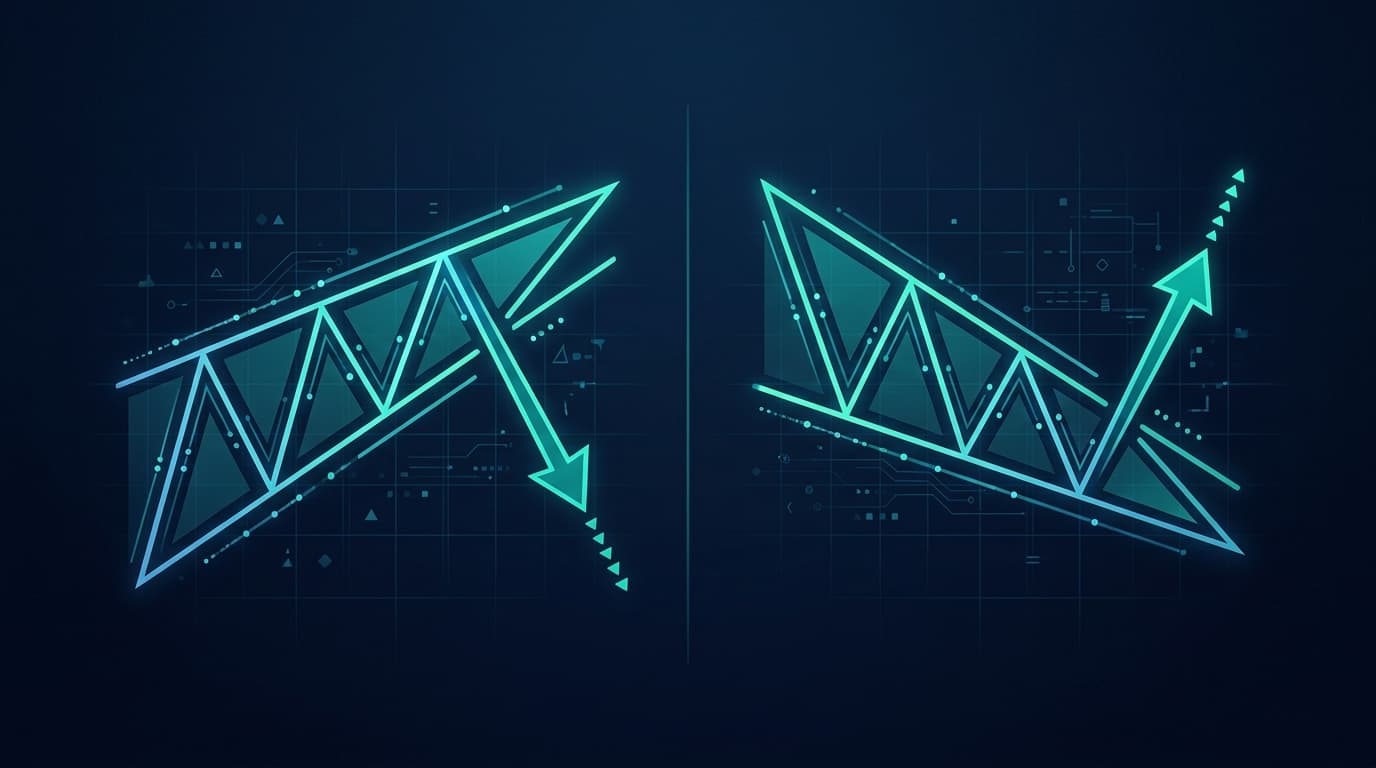
Flag patterns differ from pennant patterns in one important way: flags have parallel or nearly parallel boundaries (forming a channel), while pennants have converging boundaries (forming a small triangle). Both are continuation patterns with similar trading rules and measured move calculations, but the shape of the consolidation is what distinguishes them.
Bull Flag Anatomy
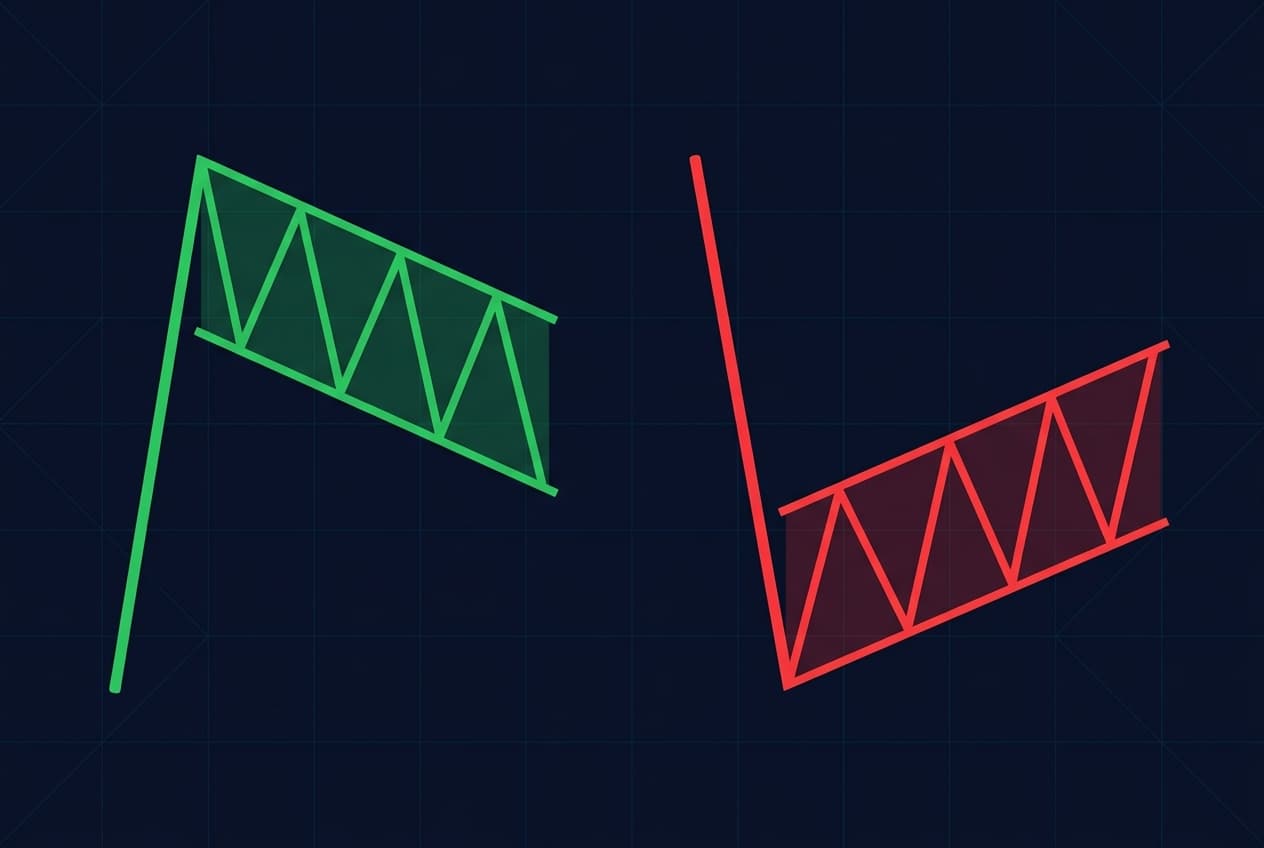
A bull flag forms during an uptrend and signals that the rally is likely to continue after a brief pause.
The pole: The pole is a sharp, near-vertical rally on strong volume. This move typically covers 5% to 15% or more in a short period (days to a couple of weeks). The steeper and stronger the pole, the more powerful the pattern tends to be. The pole represents aggressive buying and often occurs after a catalyst such as an earnings beat, a breakout from a longer consolidation, or sector-wide momentum.
The flag: After the pole completes, the price drifts slightly downward or moves sideways in a tight, orderly channel. This channel should have a slight downward slope (counter-trend) or remain roughly horizontal. The flag typically retraces no more than 38% to 50% of the pole's height. If the flag retraces more than 50%, the pattern becomes less reliable because it suggests that selling pressure is stronger than a typical profit-taking pause.
Volume during the flag: Volume should decline steadily during the flag's formation. This contraction is critical because it confirms that the pullback is driven by light profit-taking rather than heavy institutional selling. If volume remains elevated or increases during the flag, the consolidation may be a distribution phase rather than a healthy pause.
Flag duration: The flag typically lasts 1 to 4 weeks. Patterns that consolidate for more than 5 weeks begin to lose their continuation characteristics and may evolve into a different pattern entirely (such as a channel or rectangle).
The breakout: The pattern is confirmed when the price breaks above the flag's upper boundary on expanding volume. This breakout signals that buyers have absorbed the sellers and momentum is resuming. The breakout candle should ideally close above the flag's upper trendline, not just pierce it intraday.
Bear Flag Anatomy
A bear flag is the mirror image of a bull flag, forming during a downtrend and signaling that the decline is likely to continue.
The pole: A sharp, steep decline on strong volume. This drop may be triggered by negative earnings, a breakdown below support, or broader market weakness. The pole represents aggressive selling and panic from holders who want out.
The flag: After the sharp drop, the price drifts slightly upward or sideways in a tight channel. This counter-trend bounce is often called a "dead cat bounce" when it occurs in a broader downtrend. The flag should retrace no more than 38% to 50% of the pole's decline. A deeper retrace weakens the bearish signal.
Volume during the flag: Volume declines during the flag, confirming that the bounce is driven by short-covering and bargain-hunting rather than genuine institutional buying. Low volume on the bounce is bearish because it shows that buyers lack conviction.
The breakdown: The pattern confirms when the price breaks below the flag's lower boundary on expanding volume. This breakdown triggers a new wave of selling as trapped buyers from the flag's bounce cut their losses and new short sellers enter.
Side-by-Side Comparison
Understanding the differences and similarities between bull and bear flags helps you identify them quickly on any chart.
| Feature | Bull Flag | Bear Flag |
|---|---|---|
| Preceding move | Sharp rally (pole up) | Sharp decline (pole down) |
| Flag slope | Slight downward or sideways | Slight upward or sideways |
| Breakout direction | Upward (above flag top) | Downward (below flag bottom) |
| Pole volume | High, above average | High, above average |
| Flag volume | Declining, below average | Declining, below average |
| Breakout volume | Expanding, above average | Expanding, above average |
| Max flag retracement | 38-50% of pole | 38-50% of pole |
| Typical duration | 1-4 weeks | 1-4 weeks |
The core similarity is that both patterns feature strong volume on the pole, declining volume during the flag, and expanding volume on the breakout. The direction of the pole and the breakout are what differentiate the two.
Volume Characteristics That Confirm Each Pattern
Volume is the single most important confirmation tool for flag patterns. Without proper volume behavior, a flag-shaped price pattern may be something else entirely.
Pole volume must be strong: The initial impulsive move (the pole) should occur on above-average volume. This confirms that the move was driven by genuine participation from institutional traders and not a thin-market anomaly. A pole on weak volume is not a reliable pole.
Flag volume must contract: During the flag's consolidation, volume should decline steadily. Each day or week within the flag should show lower volume than the pole. This contraction signals that the counter-trend drift is a passive, low-participation event. Think of it as the market catching its breath before the next push.
Breakout volume must expand: The breakout from the flag should occur on volume that is at least 50% above the 20-day moving average volume. This expansion confirms that fresh capital is entering in the direction of the original trend. A breakout on volume that is below average or equal to average is suspect and has a higher failure rate.
If volume does not confirm the pattern at each of these three stages, treat the signal with skepticism. Price patterns without volume confirmation are unreliable.
Entry, Stop-Loss, and Target Strategies
Bull flag entry: Enter when the price closes above the flag's upper trendline on above-average volume. Some traders add a small buffer above the trendline (for example, $0.10 or 0.1%) to reduce the chance of a false breakout. Avoid entering before the breakout is confirmed, as the flag could continue drifting lower.
Bear flag entry: Enter short (or buy puts) when the price closes below the flag's lower trendline on above-average volume. Apply the same buffer logic: wait for a clear close below the boundary rather than acting on an intraday pierce.
Stop-loss for bull flags: Place your stop just below the flag's lowest point. If the breakout is genuine, the price should not revisit the bottom of the flag. This stop placement defines your risk per share. For example, if you enter at $55 on the breakout and the flag low is $52, your risk is $3 per share.
Stop-loss for bear flags: Place your stop just above the flag's highest point. If the breakdown is genuine, the price should not revisit the top of the flag.
Measured move target: The target is calculated by measuring the length of the pole and projecting that distance from the breakout point. For a bull flag: if the pole runs from $40 to $54 (a $14 move) and the breakout occurs at $52 (after the flag drifted from $54 to $52), the target is $52 + $14 = $66. The same calculation applies in reverse for bear flags.
Risk-to-reward example: Using the numbers above, entry at $52, stop at the flag low of $49 (risk of $3), target at $66 (reward of $14). That produces a risk-to-reward ratio of roughly 1:4.7, which is excellent.
False Flags and How to Avoid Them
Not every consolidation after a strong move is a valid flag pattern. Here are the warning signs that a flag may fail:
Excessive retracement: If the flag retraces more than 50% of the pole's range, the sellers are too active for a simple profit-taking pause. This suggests the original trend may be reversing rather than pausing. Treat deep retracements as a different pattern (possibly a reversal).
Extended duration: Flags that last longer than 4 to 5 weeks lose their reliability. The "energy" from the pole dissipates over time, and the market's attention shifts to other setups. A consolidation lasting more than 5 weeks is better classified as a rectangle or channel.
Rising volume during the flag: If volume increases during the flag rather than declining, this indicates active participation in the counter-trend move, not a passive drift. Rising volume during a bull flag suggests institutional selling, which contradicts the continuation thesis.
Resistance or support barriers: A bull flag forming just below a major resistance zone may fail because the breakout runs directly into a wall of sell orders. Similarly, a bear flag just above major support may fail because buyers step in at the support level.
Do not front-run the breakout: Wait for confirmation. Many traders lose money by buying into the flag before the breakout, hoping to get a better price. If the flag breaks down instead of up (for a bull flag), these premature entries result in unnecessary losses.

How PatternPilotAI Detects Flag Patterns
Manually scanning hundreds of charts for flag patterns is time-consuming and prone to subjective interpretation. PatternPilotAI automates this process by analyzing price structure, volume behavior, and trend context simultaneously.
Pole detection: The AI identifies sharp, above-average moves in either direction and measures their slope, duration, and volume profile to confirm they qualify as valid poles.
Flag classification: The consolidation phase is analyzed for its slope, retracement depth, duration, and volume trend. The AI distinguishes between flags, pennants, and other consolidation patterns based on boundary geometry.
Breakout readiness scoring: Before the breakout occurs, the AI assigns a readiness score based on how closely the pattern matches the ideal flag characteristics. This helps traders focus on the highest-quality setups.
Upload any chart to get an instant analysis of flag patterns and other chart formations. Sign up for free to start analyzing your charts today.
Ready to analyze your charts?
Try PatternPilotAI free. Upload any chart and get an AI-powered trade plan in seconds.
Get Started Free