The Complete Guide to Candlestick Patterns for Beginners

Reading a Candlestick
Every candlestick on a chart encodes four pieces of information: the opening price, the closing price, the highest price reached during the period, and the lowest price reached. Understanding how to read this information visually is the foundation for all candlestick pattern analysis.
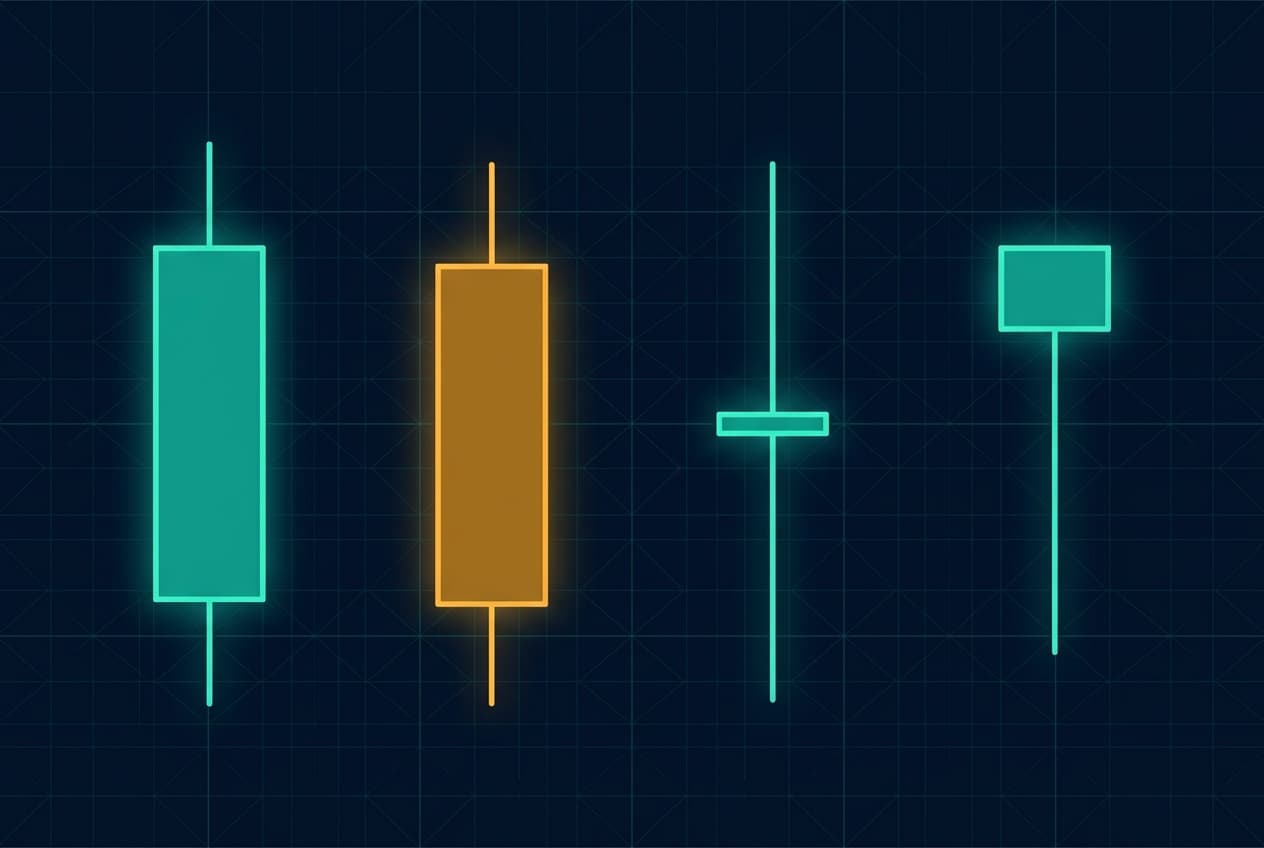
The body of the candlestick represents the range between the open and close. If the close is above the open, the body is typically colored green or white, indicating a bullish candle where buyers pushed price higher during the session. If the close is below the open, the body is red or black, indicating a bearish candle where sellers dominated.
The wicks (also called shadows) extend above and below the body. The upper wick stretches from the top of the body to the session high. The lower wick extends from the bottom of the body to the session low. Long wicks indicate that price traveled significantly beyond the opening and closing range but was pushed back by opposing pressure. A long lower wick on a bullish candle means sellers pushed price down aggressively during the session, but buyers fought back and closed near the highs.
Body size matters. A large body indicates strong conviction in one direction. A small body indicates indecision or equilibrium between buyers and sellers. The relationship between body size and wick length tells you the story of each trading period.
| Candle Feature | Bullish Meaning | Bearish Meaning |
|---|---|---|
| Large body | Strong buying pressure | Strong selling pressure |
| Small body | Indecision, potential pause | Indecision, potential pause |
| Long lower wick | Buyers rejected lower prices | Selling attempt failed |
| Long upper wick | Buying attempt failed | Sellers rejected higher prices |
| No upper wick | Closed at the high (very bullish) | Opened at the high (strong selling) |
| No lower wick | Opened at the low (strong buying) | Closed at the low (very bearish) |
Bullish Candlestick Patterns
These patterns signal that buying pressure is increasing or that a decline may be ending.
Hammer. A hammer forms at the bottom of a downtrend. It has a small body near the top of the candle and a long lower wick that is at least twice the length of the body. The color of the body matters less than the shape. The hammer tells a story: during the session, sellers pushed price sharply lower, but buyers stepped in aggressively and pushed price back up to close near the open. That rejection of lower prices, after a sustained decline, suggests the selling pressure is exhausted.
A hammer works best when it forms at established support levels. A hammer at support is a stronger signal than a hammer in the middle of nowhere. Confirmation comes from the next candle closing above the hammer's body.
Bullish engulfing. This is a two-candle pattern. The first candle is bearish (red body). The second candle is bullish (green body) and its body completely engulfs the previous candle's body. The second candle opens below the first candle's close and closes above the first candle's open.
The engulfing pattern indicates a decisive shift in control from sellers to buyers. The larger the engulfing candle relative to the preceding candle, the stronger the signal. Bullish engulfing patterns at the end of downtrends or at support levels are reliable reversal signals.
Morning star. A three-candle pattern that forms at the bottom of a downtrend. The first candle is a large bearish candle continuing the decline. The second candle is a small-bodied candle (often a doji or spinning top) that gaps below the first candle's close, showing that selling pressure is decelerating. The third candle is a large bullish candle that closes well into the body of the first candle.
The morning star represents a clear narrative: strong selling, followed by indecision, followed by strong buying. The pattern is most reliable when the third candle closes above the midpoint of the first candle's body and when volume increases on the third candle.
Piercing line. A two-candle pattern at the bottom of a downtrend. The first candle is bearish. The second candle opens below the first candle's low (a gap down) but then rallies to close above the midpoint of the first candle's body. This gap-down-then-rally action shows that bears tried to accelerate the decline but buyers overwhelmed them. The further the second candle closes into the first candle's body, the stronger the signal.
Bearish Candlestick Patterns
These patterns warn that selling pressure is increasing or that a rally may be ending.
Shooting star. The opposite of a hammer, appearing at the top of an uptrend. It has a small body near the bottom of the candle and a long upper wick at least twice the body length. During the session, buyers pushed price sharply higher, but sellers took control and drove price back down to close near the open. That rejection of higher prices after a sustained advance suggests buying pressure is exhausted.
A shooting star at resistance or at the upper boundary of a chart pattern is a high-probability reversal signal. Confirmation requires the next candle to close below the shooting star's body.
Bearish engulfing. A two-candle pattern where a large bearish candle completely engulfs the body of the preceding bullish candle. The second candle opens above the first candle's close and closes below the first candle's open, showing a decisive shift from buyers to sellers. This pattern at the end of an uptrend or at resistance indicates the start of a potential reversal.
Evening star. The mirror image of the morning star. A large bullish candle is followed by a small-bodied candle that gaps above (showing buying deceleration), followed by a large bearish candle that closes well into the body of the first candle. This three-candle sequence at the top of a rally is a classic reversal signal, especially when the third candle is accompanied by increased volume.
Dark cloud cover. The bearish counterpart to the piercing line. A bullish candle is followed by a bearish candle that opens above the first candle's high (a gap up) but then sells off to close below the midpoint of the first candle's body. The initial gap up attracted the last optimistic buyers, but sellers overwhelmed them and drove price back down. The pattern signals the transition from buying to selling control.
Doji Candles: Indecision and Context
A doji forms when the open and close are virtually identical, creating a candle with no meaningful body, just a cross or plus shape with upper and lower wicks. The doji represents perfect equilibrium between buyers and sellers during that period. Neither side was able to gain a lasting advantage.
A doji by itself is neutral. Its significance depends entirely on context.
After a sustained uptrend, a doji signals that the buying momentum that powered the rally has stalled. Buyers and sellers are now in balance, and the trend may be about to reverse. This is especially true if the doji appears at resistance.
After a sustained downtrend, a doji signals that selling pressure has diminished. The bears, who had been in control, are now being matched by incoming buyers. This can precede a reversal higher, particularly at support.
In the middle of a range, a doji is noise. It simply reflects the ongoing equilibrium of a range-bound market.
There are several doji variations. A long-legged doji has very long upper and lower wicks, showing extreme indecision with wild price swings in both directions. A dragonfly doji has a long lower wick and no upper wick, resembling a hammer; it is bullish at the bottom of a downtrend. A gravestone doji has a long upper wick and no lower wick, resembling a shooting star; it is bearish at the top of an uptrend.

Where Candlestick Patterns Work Best
Candlestick patterns are not equally reliable in all situations. Their accuracy depends heavily on location and context.
At support and resistance levels. A hammer at a tested support level is far more significant than a hammer in the middle of a trend. Support and resistance create structural context that gives candlestick patterns their predictive power. Without that structure, many candlestick patterns are random noise.
After extended trends. Reversal candlestick patterns are most meaningful after a sustained move in one direction. A bearish engulfing after five consecutive green candles at a multi-week high is significant. A bearish engulfing on the third candle of a choppy range means very little.
At chart pattern boundaries. Candlestick patterns at the neckline of a double bottom, at the support line of a triangle, or at the boundary of a flag pattern provide confirmation signals for the larger pattern. A bullish engulfing at the support line of an ascending triangle significantly increases the probability that the support will hold and the pattern will resolve upward.
On higher timeframes. Candlestick patterns on daily and weekly charts are more reliable than those on 5-minute or 15-minute charts. The shorter the timeframe, the more random the candlestick formations tend to be. A weekly hammer at major support is a powerful signal. A 5-minute hammer in the middle of a trading session may mean nothing.
Combining Candlestick Patterns with Chart Patterns
The most effective use of candlestick analysis is as a confirmation tool within the broader context of chart pattern recognition.
A head and shoulders pattern is more reliable when the right shoulder includes bearish candlestick patterns (shooting stars, bearish engulfing candles) confirming that buyers are failing at the neckline resistance. A bullish flag pattern is more reliable when the breakout candle is a large bullish engulfing that swallows the previous few candles of consolidation.
Rather than trading candlestick patterns in isolation, use them to time entries within larger chart pattern setups. The chart pattern defines the trade idea (direction, target, stop-loss). The candlestick pattern confirms the timing of entry.
How AI Reads Candlestick Formations
PatternPilotAI analyzes candlestick formations as part of its comprehensive chart evaluation. The AI identifies significant individual candles and multi-candle patterns within the context of the broader chart structure. A hammer identified by the AI at the bottom of a recognized double bottom pattern receives different treatment than a hammer appearing in a trendless consolidation.
This contextual analysis mirrors how experienced traders read candles: not as isolated signals but as confirmation of the structural story the chart is telling.
Upload your charts and see how candlestick context factors into AI pattern analysis. Sign up for free and test how PatternPilotAI identifies key candlestick formations within the patterns it detects.
Ready to analyze your charts?
Try PatternPilotAI free. Upload any chart and get an AI-powered trade plan in seconds.
Get Started Free