Triangle Patterns: Symmetrical, Ascending, and Descending

What Triangle Patterns Represent
Triangle patterns are among the most common formations in technical analysis. They form when price action contracts into a narrowing range, creating converging trend lines that visually resemble a triangle. This contraction represents a period of indecision where buyers and sellers are reaching equilibrium, building pressure that eventually resolves in a breakout.
Think of a triangle as a coiled spring. As the range narrows, energy accumulates. Buyers and sellers test each other in an increasingly tight space. When one side finally overwhelms the other, the resulting breakout often produces a sharp, directional move proportional to the energy that was stored during the contraction.
There are three types of triangle patterns, each with different structural characteristics and directional biases: symmetrical triangles (neutral), ascending triangles (bullish), and descending triangles (bearish). Understanding the differences between them helps you anticipate the most likely breakout direction and plan your trades accordingly.
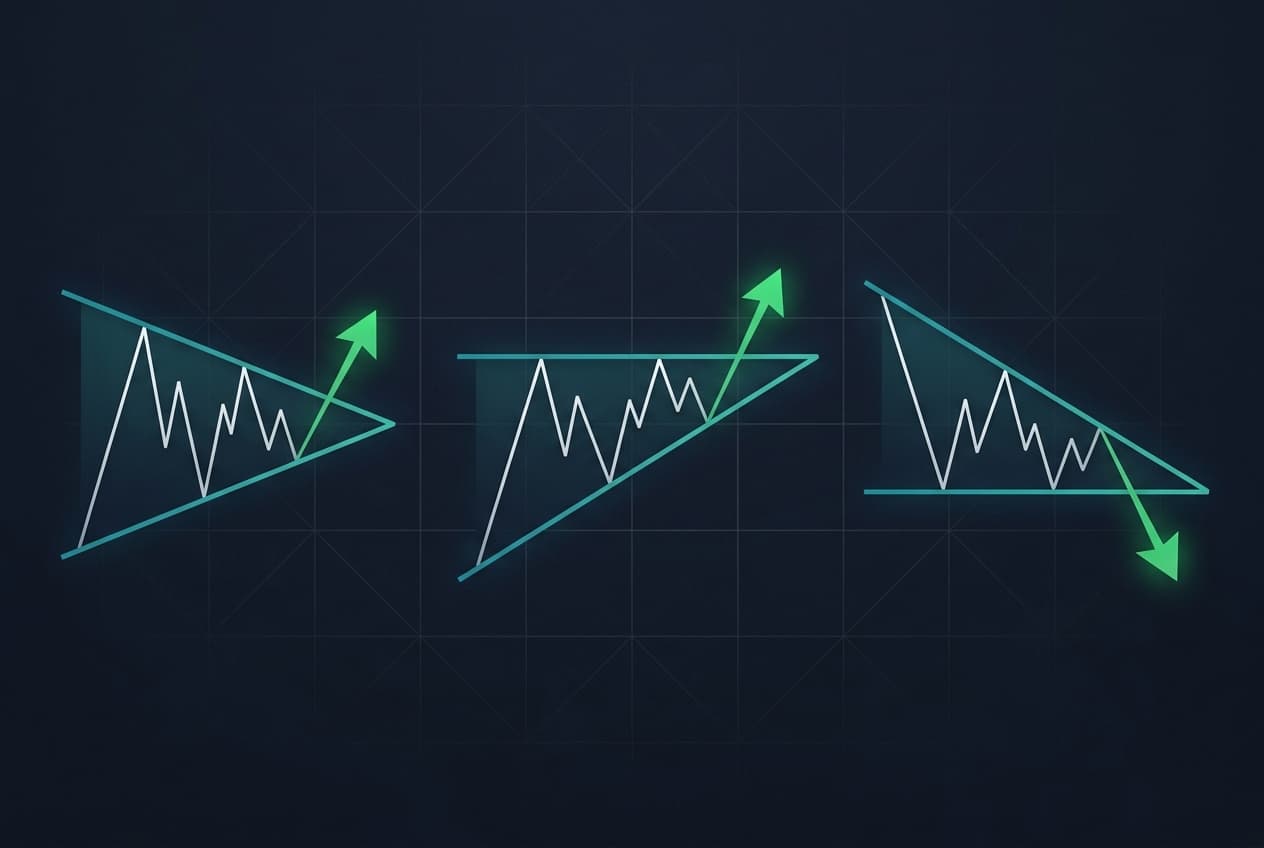
Symmetrical Triangle: Converging Lines, Neutral Bias
A symmetrical triangle forms when price makes a series of lower highs and higher lows, creating two converging trend lines that slope toward each other at roughly equal angles. Neither buyers nor sellers are in clear control, which is why this pattern has a neutral directional bias.
Structure: The upper trend line connects at least two lower highs, sloping downward. The lower trend line connects at least two higher lows, sloping upward. The two lines converge toward an apex (the point where they would eventually meet). The widest part of the triangle, measured from the first high to the first low, is called the base.
What it means: Sellers are willing to sell at progressively lower prices (creating lower highs), and buyers are willing to buy at progressively higher prices (creating higher lows). The range is compressing. Both sides are becoming more aggressive, tightening the battlefield. Eventually, one side will capitulate, and the price will break out.
Directional bias: Symmetrical triangles are considered neutral because the breakout can occur in either direction. However, context matters. A symmetrical triangle forming within a strong uptrend is more likely to break upward (continuation). A symmetrical triangle forming within a strong downtrend is more likely to break downward. When there is no clear prior trend, the breakout direction is genuinely uncertain and you should wait for confirmation before entering.
Volume during formation: Volume typically decreases steadily as the triangle develops. This declining volume reflects the shrinking range and the indecision among participants. As the pattern nears its apex, volume often reaches its lowest point, creating the "calm before the storm" that precedes the breakout.
Breakout characteristics: The breakout should occur on a significant increase in volume. A breakout without volume expansion is unreliable and has a higher probability of being a false breakout. The breakout typically occurs in the first two-thirds of the triangle's length (measured from the base to the apex). Breakouts that occur too close to the apex tend to be weak because the pattern has lost its stored energy.
Ascending Triangle: Flat Resistance, Rising Support
An ascending triangle forms when price encounters a horizontal resistance level that it cannot break above, while simultaneously making higher lows. The upper trend line is flat (connecting two or more equal highs), and the lower trend line slopes upward (connecting two or more higher lows).
Structure: The flat upper boundary represents a fixed resistance level where sellers consistently defend their positions. The rising lower boundary shows that buyers are stepping in at progressively higher prices, willing to pay more each time the price pulls back. Each pullback is shallower than the last.
What it means: Buyers are increasingly aggressive, absorbing selling pressure at higher and higher levels. Sellers are holding firm at the resistance level but are not pushing the price lower. This dynamic creates an inherent bullish bias because the buyers are gaining ground while the sellers are merely holding their line.
Why it is bullish: Imagine resistance at $50. The first pullback from $50 reaches $44. The second pullback only reaches $46. The third reaches $47.50. Each time, buyers are willing to pay more, demonstrating growing demand. Meanwhile, the sell orders at $50 are being tested repeatedly. Eventually, the accumulated buying pressure overwhelms the sellers at $50, and the price breaks through on expanded volume.
Volume during formation: Volume often increases slightly on the rallies toward resistance and decreases on the pullbacks, confirming the bullish pressure. Overall volume tends to decline as the pattern develops, with the lowest volume typically occurring just before the breakout.
Breakout confirmation: A valid breakout occurs when price closes above the flat resistance on above-average volume. The breakout candle should close above the resistance, not just pierce it intraday. Intraday pierces that reverse by the close are common and do not constitute confirmed breakouts.
Failure scenario: Although ascending triangles have a bullish bias, they can fail. If price breaks below the rising lower trend line on volume, the pattern fails and becomes bearish. The previous higher lows that formed the support line now act as a downward staircase of broken levels. Failed ascending triangles often produce sharp downside moves because all the buyers who accumulated during the pattern are now trapped.
Descending Triangle: Flat Support, Falling Resistance
A descending triangle is the bearish mirror image of an ascending triangle. Price maintains a horizontal support level while making lower highs. The lower trend line is flat (connecting two or more equal lows), and the upper trend line slopes downward (connecting two or more lower highs).
Structure: The flat lower boundary represents a fixed support level where buyers consistently defend their positions. The falling upper boundary shows that sellers are stepping in at progressively lower prices, willing to sell for less each time the price bounces.
What it means: Sellers are increasingly aggressive, pushing the price down to the support level from lower and lower starting points. Buyers are holding firm at support but are unable to push the price higher. This dynamic creates a bearish bias because sellers are gaining ground while buyers are merely defending.
Why it is bearish: Imagine support at $30. The first rally from $30 reaches $38. The second rally only reaches $35. The third reaches $33. Each time, sellers are willing to sell at lower prices, demonstrating growing supply. The support at $30 is being tested repeatedly, weakening with each test. Eventually, the support breaks and the accumulated selling pressure drives the price lower.
Volume during formation: Volume often increases on the declines toward support and decreases on the rallies, confirming the bearish pressure. As with other triangles, overall volume tends to decline as the pattern nears completion.
Breakout confirmation: A valid breakdown occurs when price closes below the flat support on above-average volume. Wait for the candle to close below support rather than acting on an intraday break.
Failure scenario: Descending triangles can fail upward. If price breaks above the declining upper trend line on volume, trapped sellers must cover and the reversal can be sharp. Failed descending triangles produce strong upside moves for the same reason failed ascending triangles produce sharp downside: the accumulated positions on the wrong side unwind rapidly.
How to Draw Triangle Trend Lines Correctly
Accurate trend line placement is essential. Poorly drawn lines lead to false patterns and bad trades.
Minimum touch points: Each trend line needs at least two touches to be valid. Three touches provide stronger confirmation. A trend line drawn through only one point is arbitrary and meaningless.
Connect wicks or closes? Use the same methodology consistently. Some analysts draw lines through candle wicks (the absolute highs and lows), while others use closing prices. Wicks capture the full range of price action, while closes filter out intraday noise. Both approaches are valid; the key is consistency.
Do not force the lines. If the price points do not naturally form a clean trend line, the pattern may not be a triangle. Forcing trend lines through points that do not quite align leads to false pattern identification. Valid triangles have trend lines that the price clearly respects.
Allow small violations. A candle that briefly pierces a trend line by a small amount but closes back inside the triangle is not necessarily a breakout. These "whisker violations" are common. The breakout is confirmed by a close outside the triangle on expanded volume, not by a brief intraday pierce.
Identify the apex. Extend the trend lines until they meet. The apex tells you approximately when the pattern must resolve. Triangles typically break out in the first two-thirds of the distance from the base to the apex. If the price reaches the apex without breaking out, the pattern has likely failed and the expected directional move is no longer in play.
Volume Pattern: Decreasing During Formation, Spike on Breakout
Volume behavior within triangle patterns follows a predictable and important sequence.
Phase 1 (early formation): Volume is relatively normal as the first swings establish the pattern's boundaries. Traders are still active, and the range is wide enough for meaningful moves.
Phase 2 (mid-formation): Volume begins declining as the range narrows. With less room for price movement, fewer traders are motivated to act. This declining volume is healthy and expected. It confirms that the consolidation is a pause, not active distribution or accumulation in disguise.
Phase 3 (pre-breakout): Volume reaches its lowest levels just before the breakout. The market is quiet. Participation is minimal. This calm is the strongest signal that a breakout is imminent, because the extreme lack of activity cannot persist indefinitely.
Phase 4 (breakout): Volume expands sharply on the breakout candle. This volume spike confirms that new participants are entering and existing participants are acting decisively. A breakout without this volume expansion is suspect and has a higher probability of failure.
The volume test: If a triangle breaks out on volume that is below average, exercise extreme caution. Many false breakouts occur on weak volume because there is insufficient participation to sustain the move. The price may briefly push outside the triangle only to reverse back inside within one to three bars.
Measuring the Expected Move
Triangle patterns provide a built-in method for calculating a minimum price target after breakout.
The calculation: Measure the height of the triangle at its widest point (the base). This is the distance between the first high and the first low that define the pattern's boundaries. Then project that distance from the breakout point in the direction of the break.
Ascending triangle example: A stock has flat resistance at $50 and the first low of the ascending triangle is at $42. The base height is $8. When the stock breaks above $50, the minimum target is $50 + $8 = $58.
Descending triangle example: A stock has flat support at $30 and the first high of the descending triangle is at $37. The base height is $7. When the stock breaks below $30, the minimum target is $30 - $7 = $23.
Symmetrical triangle example: The first high is at $55 and the first low is at $45. The base height is $10. If the breakout is upward at $51, the target is $51 + $10 = $61. If the breakout is downward at $49, the target is $49 - $10 = $39.
This measured move target is a minimum expectation. Strong breakouts often exceed the target, particularly when the breakout aligns with the broader trend and occurs on strong volume.

False Breakouts in Triangle Patterns
False breakouts are a reality of triangle trading. Understanding why they happen and how to manage them is essential.
Why false breakouts occur: The converging trend lines of a triangle create obvious levels that many traders watch. This attracts stop-loss orders and pending entry orders just outside the triangle's boundaries. Market makers and large participants sometimes push the price briefly beyond these levels to trigger these orders (collecting liquidity) before reversing the price back inside the triangle.
How to filter false breakouts:
-
Wait for the close. Do not enter on an intraday break of the trend line. Wait for the candle to close outside the triangle. A close outside the pattern is a far stronger signal than a wick that briefly pierces the boundary.
-
Require volume confirmation. A breakout on volume that is at least 50% above the 20-day average is much less likely to be false than a breakout on average or below-average volume.
-
Check the context. A breakout that aligns with the broader trend (e.g., an ascending triangle breaking upward in an uptrend) is more reliable than one that contradicts it.
-
Use the two-thirds rule. Breakouts in the first two-thirds of the triangle (measured from base to apex) are more reliable than those near the apex. Late breakouts lack the stored energy to produce a sustained move.
Trading Each Triangle Type: Entry, Stop-Loss, and Target
Ascending triangle (bullish bias):
- Entry: Buy on a close above flat resistance with above-average volume
- Stop-loss: Below the most recent higher low within the triangle
- Target: Resistance level plus the height of the triangle's base
- Risk management: Size your position based on the distance from entry to stop, using proper position sizing rules
Descending triangle (bearish bias):
- Entry: Sell short on a close below flat support with above-average volume
- Stop-loss: Above the most recent lower high within the triangle
- Target: Support level minus the height of the triangle's base
- Risk management: Same position sizing approach, ensuring the potential loss is an acceptable percentage of your account
Symmetrical triangle (neutral):
- Entry: Trade in the direction of the breakout once confirmed by a close outside the triangle on volume
- Stop-loss: On the opposite side of the triangle from your entry (above the upper trend line for shorts, below the lower trend line for longs)
- Target: Breakout point plus (or minus) the height of the triangle's base
- Additional consideration: Because symmetrical triangles have no directional bias, some traders wait for a bull or bear flag to form after the initial breakout before entering, using the flag's breakout as a secondary confirmation
How PatternPilotAI Identifies Triangle Patterns
PatternPilotAI analyzes uploaded charts for the converging trend lines, volume profiles, and structural characteristics that define all three triangle types. The AI distinguishes between ascending, descending, and symmetrical formations based on trend line geometry and evaluates each pattern's quality.
The analysis includes the pattern type, the key support and resistance levels forming the triangle's boundaries, the current position within the formation (early, mid, or near apex), volume assessment, and the measured move target for the anticipated breakout. A confidence score reflects how closely the current formation matches historical patterns with high completion rates.
Whether you are watching a potential ascending triangle near resistance or a symmetrical triangle coiling tighter each day, upload your chart for an instant assessment. Sign up for free and get a detailed triangle pattern analysis with entry, stop-loss, and target recommendations.
Ready to analyze your charts?
Try PatternPilotAI free. Upload any chart and get an AI-powered trade plan in seconds.
Get Started Free