MACD: The Momentum Indicator Every Trader Should Understand

What MACD Measures
MACD stands for Moving Average Convergence Divergence. It measures the relationship between two exponential moving averages of price. When the shorter-term average is above the longer-term average, momentum is bullish. When the shorter-term average is below the longer-term average, momentum is bearish. The distance between these two averages tells you how strong that momentum is.
What makes MACD useful for traders is that it captures both trend direction and trend strength in a single indicator. A stock can be in an uptrend, but if the MACD is declining, the uptrend is losing steam. This early warning of weakening momentum often appears before price itself shows signs of trouble, giving attentive traders time to adjust their positions or tighten stops.
MACD belongs to the oscillator family of indicators, but unlike bounded oscillators such as RSI that move between fixed values (0 to 100), MACD has no upper or lower limit. Its value depends on the absolute price of the asset, which means MACD readings on a $500 stock will be numerically larger than on a $20 stock. This is not a flaw; it simply means you should interpret MACD in the context of each individual chart rather than comparing raw MACD values across different securities.
MACD Components: Line, Signal, and Histogram
MACD consists of three components that work together:
The MACD line is calculated by subtracting the 26-period exponential moving average (EMA) from the 12-period EMA. When this line is positive, the short-term average is above the long-term average, indicating bullish momentum. When negative, the opposite is true.
The signal line is a 9-period EMA of the MACD line itself. It acts as a smoother, slower version of the MACD line. The signal line helps filter out noise and identifies when momentum shifts are significant enough to act on rather than just random fluctuations.
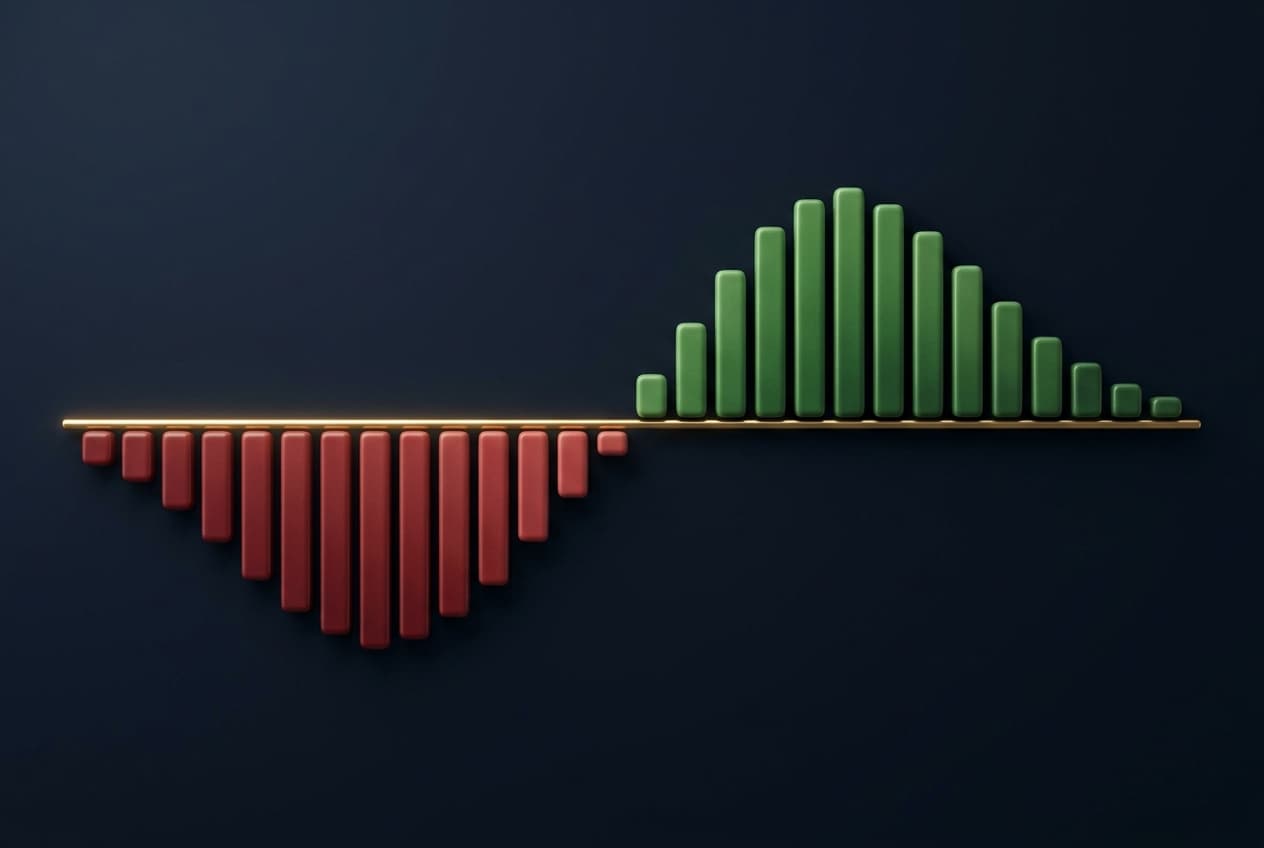
The histogram represents the difference between the MACD line and the signal line. When the MACD line is above the signal line, the histogram is positive and typically displayed as green bars above the zero line. When the MACD line is below the signal line, the histogram is negative and displayed as red bars below zero. The height of the histogram bars shows how far apart the two lines are, which reflects the rate of change in momentum.
| Component | Calculation | What It Shows |
|---|---|---|
| MACD Line | 12 EMA minus 26 EMA | Momentum direction and strength |
| Signal Line | 9 EMA of MACD Line | Smoothed momentum for crossover signals |
| Histogram | MACD Line minus Signal Line | Rate of momentum change |
Default Settings (12, 26, 9) and Why They Work
The standard MACD settings of 12, 26, and 9 periods were established by Gerald Appel, who developed the indicator in the late 1970s. These numbers were chosen based on trading weeks: 12 days is roughly two and a half trading weeks, 26 days is roughly one trading month, and 9 days provides a responsive signal line.
These defaults have persisted for decades because they strike a practical balance. The 12-period EMA responds quickly enough to capture meaningful momentum shifts without reacting to every minor price wiggle. The 26-period EMA provides a stable reference that represents the intermediate trend. The 9-period signal line smooths the MACD output without introducing excessive lag.
Some traders adjust these settings. Shorter periods (8, 17, 9) create a more responsive MACD that generates more signals but also more false alarms. Longer periods (19, 39, 9) create a smoother MACD that filters out noise but may lag behind actual turning points. For most traders, especially those still developing their skills, the default settings work well and have been validated by millions of traders over four decades of use.
MACD Crossover Signals
The most widely used MACD signal is the crossover between the MACD line and the signal line.
Bullish crossover: When the MACD line crosses above the signal line, it indicates that short-term momentum is accelerating to the upside. Traders interpret this as a potential buy signal, especially when the crossover occurs below the zero line (meaning the stock was in a downtrend and is now showing signs of reversing). A bullish crossover above the zero line is also meaningful; it confirms that an existing uptrend is gaining renewed strength after a minor pullback.
Bearish crossover: When the MACD line crosses below the signal line, short-term momentum is decelerating or turning negative. This serves as a potential sell signal or a warning to tighten stop-losses on long positions. Bearish crossovers that occur above the zero line are early warnings that an uptrend may be weakening. Bearish crossovers below the zero line confirm continued downside momentum.
Zero line crossovers carry additional significance. When the MACD line crosses above zero, the 12-period EMA has crossed above the 26-period EMA, which many traders treat as confirmation of a new uptrend. When MACD crosses below zero, the short-term trend has definitively turned bearish.
Not all crossovers are created equal. A crossover accompanied by expanding histogram bars and increasing volume is more reliable than a crossover in a flat, range-bound market. In choppy conditions, the MACD lines may whipsaw back and forth across each other, generating multiple false signals in quick succession.
MACD Histogram: Reading Momentum Shifts
The histogram deserves special attention because it often signals momentum changes before the MACD lines themselves cross.
When the histogram is above zero and the bars are growing taller, bullish momentum is increasing. When the bars start shrinking (still positive but getting shorter), bullish momentum is decelerating even though the MACD line is still above the signal line. This shrinking histogram is often the first sign that a bullish move is running out of energy.
The same logic applies in reverse. A negative histogram with bars growing longer indicates strengthening bearish momentum. Shrinking negative bars suggest the selling pressure is easing.
Histogram divergence from price is one of the earliest warning signals available to traders. If a stock makes a new price high but the histogram peak is lower than the previous histogram peak, momentum is not confirming the new high. This is a subtle but powerful signal that the rally may be exhausting itself.
Experienced traders watch the histogram more than the actual crossover signals because the histogram changes direction before the lines cross. This gives them a head start in anticipating trend changes rather than reacting to them after the fact.

MACD Divergence: When Price and MACD Disagree
Divergence between price action and MACD is one of the most powerful signals the indicator produces, and it relates directly to the concept of reversal patterns in chart analysis.
Bullish divergence occurs when price makes a lower low but the MACD makes a higher low. This tells you that even though price dropped to a new low, downside momentum was actually weaker on the second decline. The selling pressure is fading, and a reversal higher may be imminent. Bullish MACD divergence at established support levels or at the completion of a chart pattern like a double bottom is an especially strong signal.
Bearish divergence occurs when price makes a higher high but the MACD makes a lower high. Despite the new price high, upside momentum was weaker on the second rally. Buyers are losing conviction, and a reversal lower is possible. When bearish MACD divergence appears at resistance or at the right shoulder of a head and shoulders pattern, the probability of a reversal increases significantly.
Divergence signals require patience. The divergence itself does not trigger the trade; it alerts you that conditions are shifting. You still need price confirmation, such as a trendline break, a candlestick reversal pattern, or a break of a chart pattern neckline, before acting.
Combining MACD with Chart Patterns for Confirmation
MACD becomes most powerful when used alongside chart pattern analysis rather than in isolation.
When a triangle pattern approaches its apex, watch the MACD for clues about breakout direction. If the MACD line is trending higher and crossing above the signal line as price compresses, the breakout is more likely to the upside. If MACD is declining, a downside breakout becomes the higher probability outcome.
For flag and pennant patterns, MACD can confirm that the consolidation phase is a pause within a trend rather than a reversal. During a healthy bull flag, the MACD may pull back toward the signal line or the zero line without making a full bearish crossover. This "MACD hold" pattern suggests the trend remains intact and the breakout continuation is likely.
After a breakout from any chart pattern, MACD expansion (the histogram bars growing in the breakout direction) confirms genuine momentum behind the move. A breakout accompanied by a flat or declining MACD is suspicious and may represent a false breakout.
MACD on Different Timeframes
MACD works on any timeframe, but its behavior differs based on the chart period.
On daily charts, MACD signals tend to be more reliable but slower to develop. A daily MACD crossover may take several days to materialize, meaning entries may come after the initial move has already started. The tradeoff is fewer false signals.
On 1-hour or 4-hour charts, MACD generates more frequent signals that are useful for swing and intraday traders. The risk is more whipsaws during choppy sessions. Filtering these intraday signals through the direction of the daily MACD can reduce false entries.
On weekly charts, MACD signals are rare but powerful. A weekly MACD bullish crossover after an extended downtrend often marks the beginning of a significant trend change. Position traders and long-term investors watch weekly MACD closely for major turning points.
A practical approach is to use the higher timeframe MACD for direction and the lower timeframe MACD for timing. If the daily MACD is bullish, only take bullish crossovers on the 4-hour chart. This multi-timeframe alignment reduces the number of trades but significantly improves the success rate.
Limitations of MACD
MACD is a lagging indicator. Because it is derived from moving averages, it will always react to price rather than predict it. By the time a MACD crossover occurs, the initial price move that caused it is already underway. This lag is the fundamental tradeoff for the indicator's smoothing and noise reduction.
In choppy, range-bound markets, MACD produces frequent false crossover signals as price bounces back and forth without establishing a clear trend. Traders who follow every crossover mechanically during these periods will accumulate losses from repeated whipsaws. The solution is to recognize when price is ranging (using other tools like Bollinger Bands or simple visual assessment) and avoid trading MACD crossovers during those periods.
MACD should never be your only reason for entering a trade. It works best as a confirmation tool alongside price action, chart patterns, and volume analysis. A bullish MACD crossover that aligns with a breakout from a chart pattern supported by above-average volume is a strong setup. A bullish MACD crossover alone, without supporting evidence from price action, is a coin flip.
How PatternPilotAI References Momentum Indicators
PatternPilotAI incorporates momentum analysis into its chart evaluation process. When the AI identifies a chart pattern, it considers whether the momentum context supports the expected move. A bullish breakout pattern accompanied by expanding bullish momentum receives a higher confidence score than one where momentum is flat or declining.
The analysis output includes observations about momentum alignment with the detected pattern, providing traders with a more complete picture than pattern identification alone.
Test how momentum-aware chart analysis works with your own charts. Sign up for free and upload a chart to see how PatternPilotAI integrates momentum context into its pattern recognition.
Ready to analyze your charts?
Try PatternPilotAI free. Upload any chart and get an AI-powered trade plan in seconds.
Get Started Free