The 5 Most Reliable Reversal Patterns Every Trader Should Know

Why Reversal Patterns Matter
Trend reversals represent some of the highest-reward opportunities in trading. Catching the beginning of a new trend means entering before the majority of the move has occurred, and reversal patterns provide the visual framework for identifying these turning points.
A reversal pattern signals that the balance of power between buyers and sellers is shifting. In an uptrend, a reversal pattern indicates that buyers are losing control and sellers are gaining strength. In a downtrend, the opposite is true. Recognizing these patterns early allows traders to position themselves on the right side of the emerging trend.
However, not all reversal patterns are created equal. Some are far more reliable than others, and even the best patterns require confirmation before acting. The five patterns below have demonstrated consistent reliability across decades of market data when properly identified and confirmed with volume.

1. Head and Shoulders (and Inverse)
The head and shoulders is widely considered the most reliable reversal pattern in technical analysis. It marks the end of an uptrend and the beginning of a potential downtrend (or the reverse for an inverse head and shoulders).
What It Looks Like
The pattern consists of three peaks: a left shoulder, a higher central peak (the head), and a right shoulder that tops out near the same level as the left shoulder. The two troughs between the three peaks form a support line called the neckline, which can be horizontal or slightly sloped.
The inverse head and shoulders is the mirror image: three troughs with the middle one being the deepest, occurring at the end of a downtrend.
When It Appears
A head and shoulders top forms after an extended uptrend, typically over 3 to 6 months. The pattern needs a preceding trend to reverse. A head and shoulders forming in the middle of a trading range is less meaningful because there is no established trend to reverse.
How to Trade It
Enter a short position (or exit a long position) when the price breaks below the neckline. The target is calculated by measuring the distance from the top of the head to the neckline and projecting that distance downward from the neckline break point. For an inverse head and shoulders, the entry is above the neckline with the target projected upward.
Volume Confirmation
Volume plays a critical role in confirming this pattern. Ideally, volume decreases from the left shoulder to the head to the right shoulder, showing diminishing buying enthusiasm. The neckline break should occur on a spike in volume, confirming that sellers have taken control.
A common mistake is acting on a neckline break that occurs on below-average volume. These low-volume breakdowns are more likely to result in false breakouts and whipsaws.
2. Double Top and Double Bottom
The double top and double bottom are among the most frequently occurring reversal patterns. They signal exhaustion at a key price level after two failed attempts to push through.
What It Looks Like
A double top consists of two peaks at approximately the same price level, separated by a pullback. The support level between the two peaks is called the confirmation line. A double bottom is the mirror image: two troughs at roughly the same level with a rally between them.
The two peaks (or troughs) do not need to be at the exact same price. A variance of 1% to 3% is normal and expected. What matters is that the market tested a level twice and was rejected both times.
When It Appears
Double tops form after uptrends when the price reaches a resistance level it cannot break through on two separate attempts. Double bottoms form after downtrends at support levels. The pattern typically develops over 2 to 4 months.
How to Trade It
For a double top, enter a short position when the price breaks below the confirmation line (the low point between the two peaks). The target is the distance from the peaks to the confirmation line, projected downward. For a double bottom, enter long when the price breaks above the confirmation line.
Volume Confirmation
The second peak in a double top should form on lower volume than the first peak. This declining volume signals that buying enthusiasm is waning. Conversely, in a double bottom, the second trough should form on lower volume than the first, showing that selling pressure is drying up. The breakout through the confirmation line should occur on increased volume.

3. Triple Top and Triple Bottom
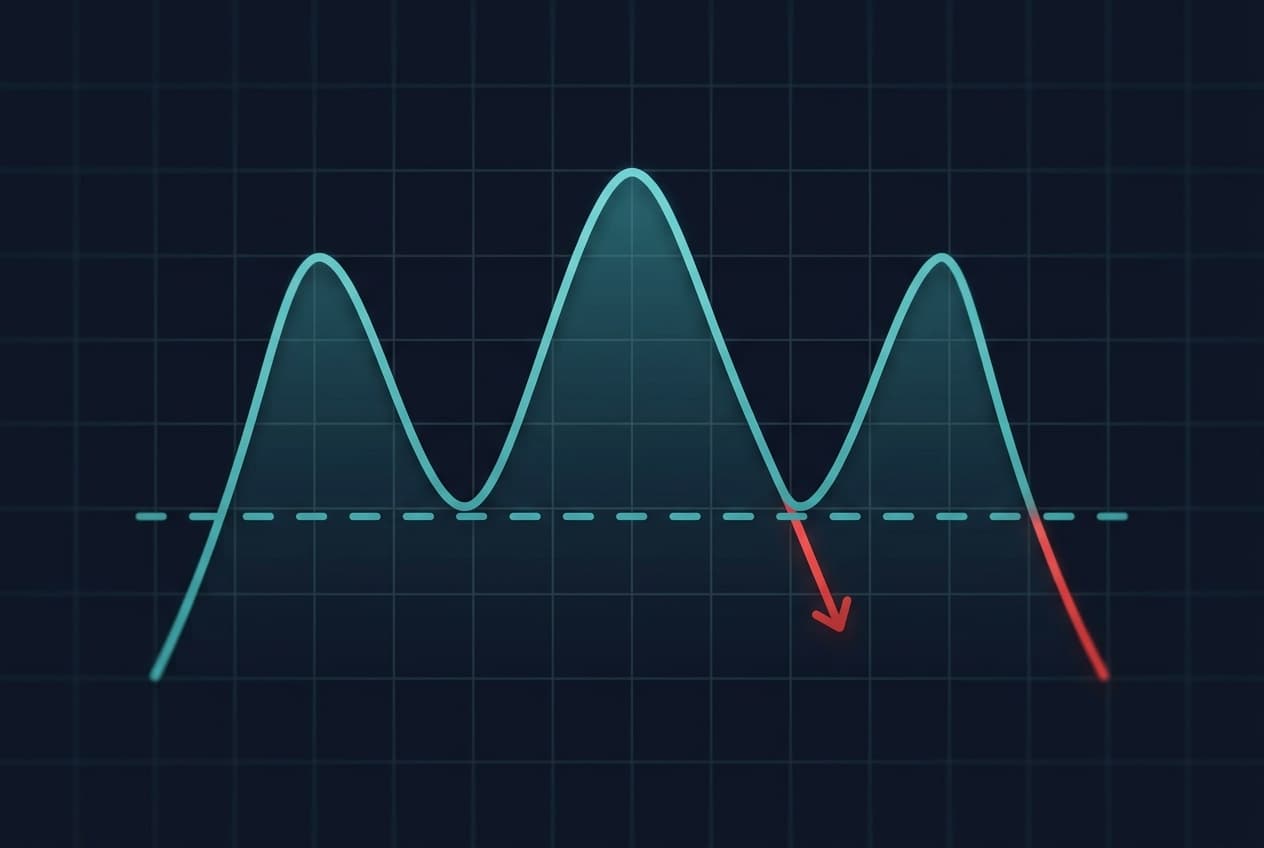
The triple top and triple bottom are essentially enhanced versions of the double top and bottom, with three tests of the same level instead of two.
What It Looks Like
Three peaks at approximately the same resistance level (triple top) or three troughs at approximately the same support level (triple bottom). The peaks or troughs should be reasonably evenly spaced over time.
When It Appears
Triple patterns are less common than double patterns because not all double patterns get a third test. When they do form, the three-test structure represents a stronger signal. The extended time frame (typically 3 to 6 months) allows for more accumulation or distribution, which tends to produce larger moves when the pattern finally resolves.
How to Trade It
The trading approach is identical to the double top/bottom: enter on a break of the confirmation line (the lowest trough between the peaks for a triple top, or the highest peak between the troughs for a triple bottom). The measured move target is the distance from the peaks/troughs to the confirmation line.
Volume Confirmation
Volume should diminish on each successive test of the level. The first test typically has the highest volume, the second has less, and the third has the least. This progressive decline in volume shows that the force behind each test is weakening. The eventual breakout should occur on a significant volume increase.
4. Rounding Bottom
The rounding bottom (sometimes called a saucer bottom) is a long-term reversal pattern that signals a gradual shift from a bearish to a bullish trend.
What It Looks Like
The pattern forms a gradual U-shaped decline and recovery over an extended period, typically several weeks to several months. Unlike the sharp V-shaped recovery, the rounding bottom is characterized by a slow, steady transition. The left side shows a gradual decline, the bottom is relatively flat, and the right side shows a gradual ascent back toward the level where the decline began (the left rim).
When It Appears
Rounding bottoms form after prolonged downtrends, typically over 2 to 12 months. They represent a slow, methodical base-building process as the stock transitions from distribution (selling) to accumulation (buying). These patterns are especially common in stocks that have been beaten down and are undergoing a fundamental turnaround.
How to Trade It
Enter a long position when the price breaks above the left rim of the rounding bottom on increased volume. The measured move target is the depth of the rounding bottom projected upward from the breakout point. Because these patterns take so long to form, the resulting breakout moves can be substantial.
Volume Confirmation
Volume follows a distinctive pattern in a rounding bottom. It is high on the left side (during the decline), decreases as the bottom forms, and steadily increases on the right side as the recovery gains momentum. This gradual volume increase on the right side is a key confirmation signal. A breakout above the rim on strong volume confirms that the reversal is underway.
5. Rising and Falling Wedge (as Reversal)
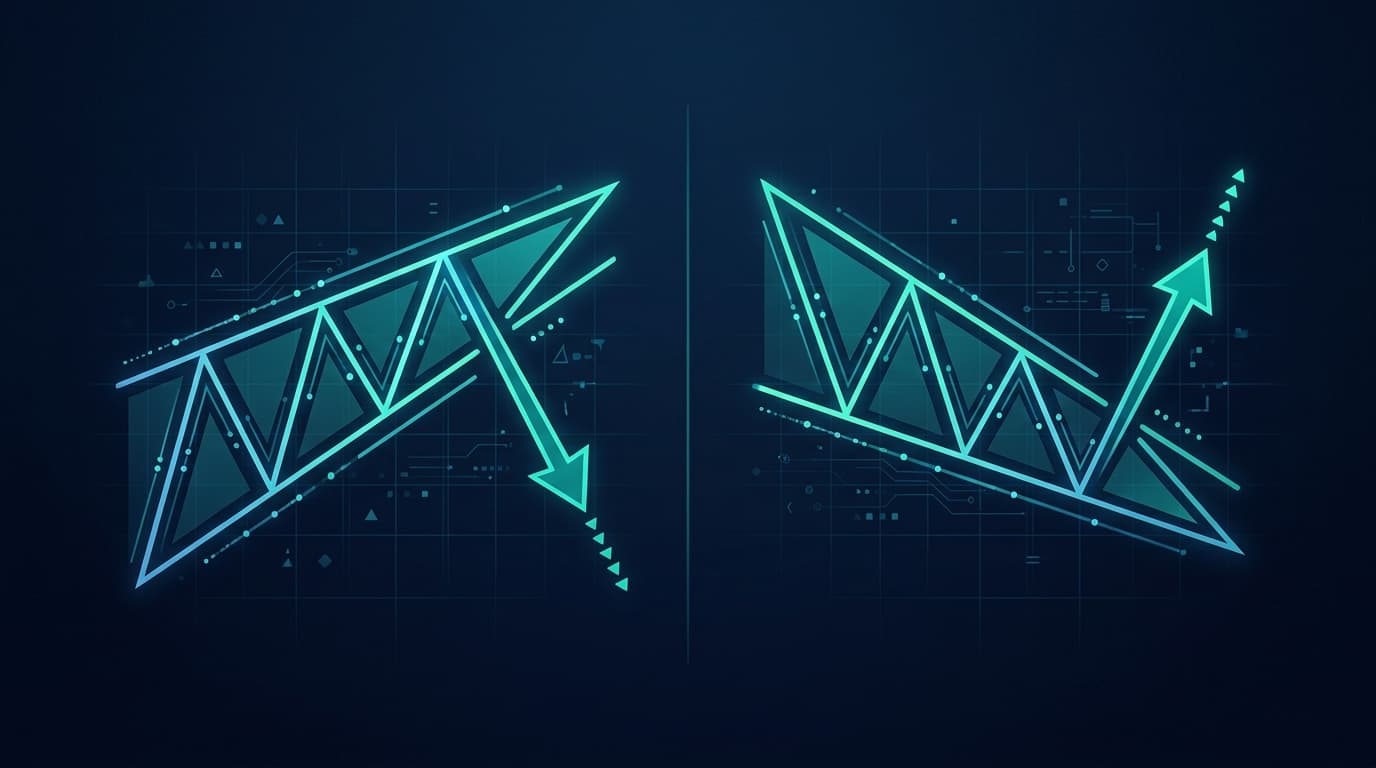
Wedges are converging trendline patterns where both the upper and lower boundaries slope in the same direction. When they appear at the end of a trend, they function as reversal patterns.
What It Looks Like
A rising wedge consists of two upward-sloping trendlines that converge as the price makes higher highs and higher lows, but the highs and lows are getting closer together. A falling wedge is the opposite: two downward-sloping, converging trendlines.
The key visual feature is the narrowing price range. As the pattern matures, the distance between the upper and lower trendlines shrinks, creating a "squeeze" that typically resolves with a breakout in the opposite direction of the wedge's slope.
When It Appears
A rising wedge at the end of an uptrend signals a bearish reversal. The rising price action within the wedge looks like the uptrend is continuing, but the narrowing range and declining momentum suggest that buyers are losing conviction. Falling wedges at the end of downtrends signal bullish reversals. These patterns typically develop over 1 to 3 months.
How to Trade It
For a rising wedge (bearish reversal), enter a short position when the price breaks below the lower trendline. For a falling wedge (bullish reversal), enter long when the price breaks above the upper trendline. The target is typically the height of the widest part of the wedge, projected from the breakout point.
Volume Confirmation
Volume should contract within the wedge as the pattern develops. This contraction reflects the narrowing range and indecision among market participants. The breakout from the wedge should occur on a significant expansion in volume, confirming that the market has resolved its indecision in a new direction.
Comparison Table
| Pattern | Reliability | Typical Timeframe | Signal Type | Volume Profile |
|---|---|---|---|---|
| Head and Shoulders | High | 3-6 months | Bearish (standard) / Bullish (inverse) | Decreasing on right shoulder |
| Double Top/Bottom | Moderate-High | 2-4 months | Bearish (top) / Bullish (bottom) | Lower on second peak/trough |
| Triple Top/Bottom | High | 3-6 months | Bearish (top) / Bullish (bottom) | Diminishing on each test |
| Rounding Bottom | Moderate | 2-12 months | Bullish | Gradual increase on right side |
| Wedge (reversal) | Moderate-High | 1-3 months | Opposite to slope direction | Contraction within wedge |
Combining Multiple Reversal Signals
Reversal patterns become significantly more reliable when they align with other technical signals:
Divergence: When the price makes a new high but an oscillator like RSI or MACD makes a lower high, this bearish divergence combined with a reversal pattern (like a head and shoulders) strengthens the signal. Bullish divergence at a double bottom similarly increases confidence.
Support and resistance levels: A reversal pattern forming at a major support or resistance level carries more weight than one forming at a random price level. Historical support and resistance zones represent areas where the market has previously demonstrated interest, adding confluence to the reversal signal.
Moving average interactions: If a reversal pattern's breakout coincides with a break of a significant moving average (50-day or 200-day), the signal gains additional credibility.
Multiple pattern types: Occasionally, two reversal signals overlap. For example, a cup and handle pattern may form at the right side of a larger rounding bottom. These overlapping patterns tend to produce particularly strong moves.
Using AI for pattern detection: Manually scanning for reversal patterns across hundreds of charts is time-consuming and inconsistent. PatternPilotAI detects these patterns automatically from chart screenshots, assigns confidence scores based on historical completion rates, and highlights the key levels for entry and exit. This allows you to focus on evaluating the highest-confidence setups rather than spending hours searching for them.
Try PatternPilotAI for free and see how AI-powered pattern detection can streamline your analysis.
Ready to analyze your charts?
Try PatternPilotAI free. Upload any chart and get an AI-powered trade plan in seconds.
Get Started Free