Bollinger Bands: Trading Volatility and Mean Reversion

What Bollinger Bands Measure
Bollinger Bands, developed by John Bollinger in the 1980s, measure price volatility relative to recent history. Unlike fixed indicators that give static readings, Bollinger Bands expand and contract dynamically as the market becomes more or less volatile. This adaptability makes them one of the most versatile tools in technical analysis.
The core insight behind Bollinger Bands is that volatility is cyclical. Periods of low volatility are followed by periods of high volatility, and vice versa. Markets compress, then expand. They consolidate, then break out. Bollinger Bands visually capture this cycle, giving traders a framework for anticipating when volatility is about to change.
At their most basic, Bollinger Bands answer a practical question: is the current price high or low relative to recent price action? When price is near the upper band, it is statistically elevated compared to its recent range. When price is near the lower band, it is statistically depressed. This relative context is more useful than trying to determine if a price is "high" or "low" in absolute terms.
Bollinger Band Components
Bollinger Bands consist of three lines plotted on the price chart:
The middle band is a 20-period simple moving average (SMA) of closing prices. This serves as the baseline representing the average price over the past 20 periods. The middle band acts as dynamic support or resistance, and its slope indicates the current trend direction.
The upper band is plotted 2 standard deviations above the middle band. This line represents the upper boundary of "normal" price behavior based on recent volatility. When price is between the middle and upper band, it is above average but within a statistically expected range.
The lower band is plotted 2 standard deviations below the middle band. It represents the lower boundary of recent normal price behavior.
| Component | Calculation | Role |
|---|---|---|
| Middle Band | 20-period SMA | Trend baseline, dynamic support/resistance |
| Upper Band | Middle Band + (2 x Standard Deviation) | Upper volatility boundary |
| Lower Band | Middle Band - (2 x Standard Deviation) | Lower volatility boundary |
With default settings (20 period, 2 standard deviations), approximately 95% of price action falls within the bands. When price moves outside the bands, it represents a statistically significant move that deserves attention.
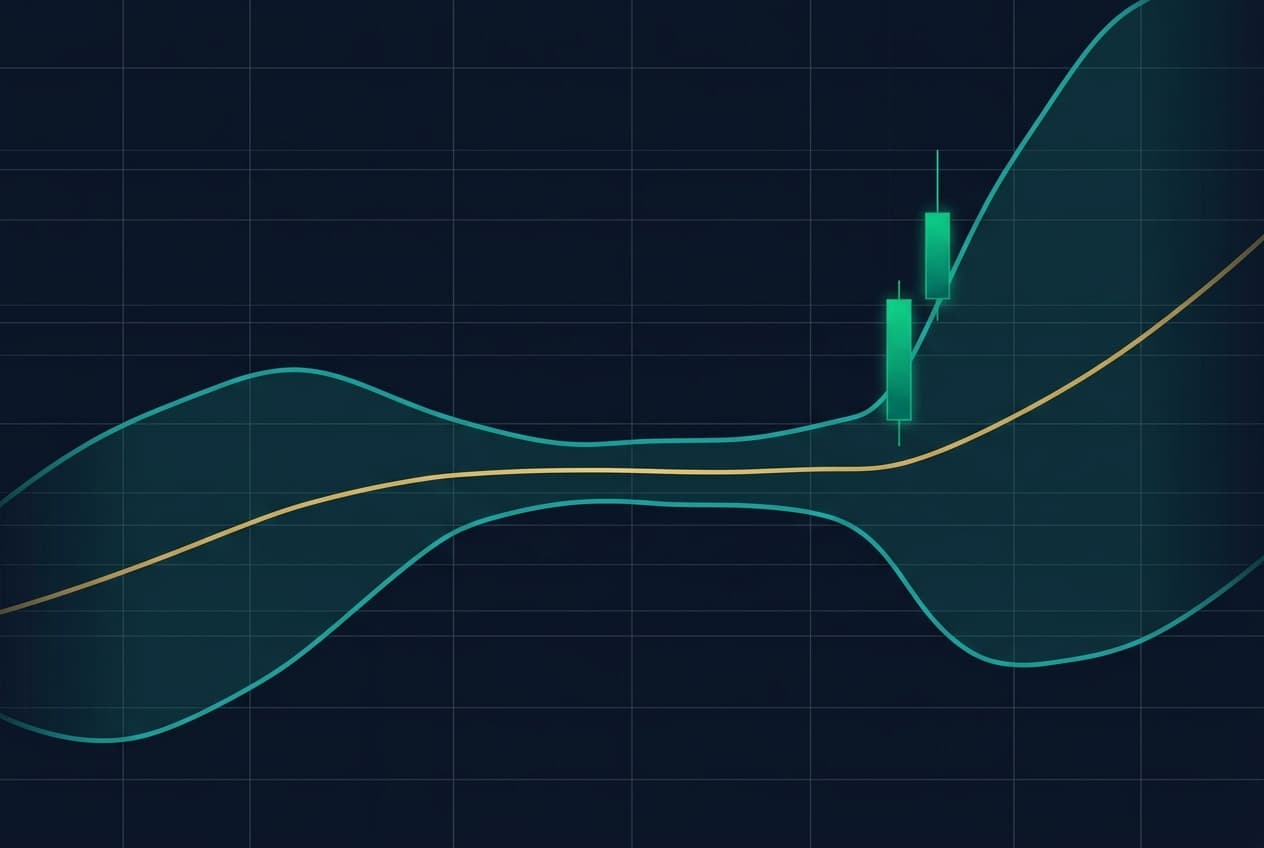
The Squeeze: Low Volatility Precedes Big Moves
The Bollinger Band squeeze is one of the most reliable setups in technical analysis. When the bands narrow significantly, it means volatility has contracted and the market is coiling for a move. The squeeze does not tell you which direction the breakout will go, but it tells you that a significant move is imminent.
Visually, a squeeze looks like the upper and lower bands pinching together, with price consolidating in a tight range between them. This compression often occurs during triangle and flag patterns, which are themselves consolidation structures.
To identify a squeeze objectively, look at Bollinger Band Width (BBW), which measures the distance between the upper and lower bands as a percentage of the middle band. When BBW reaches its lowest levels in the past 6 months, you have a squeeze. The longer the squeeze persists, the more explosive the eventual breakout tends to be.
Trading the squeeze:
- Identify the squeeze (bands at their narrowest in recent history)
- Wait for the breakout candle that closes outside one of the bands
- Enter in the direction of the breakout
- Place a stop-loss on the opposite side of the squeeze range
- Use the width of the squeeze range projected from the breakout point as an initial price target
The squeeze works because compressed volatility cannot persist indefinitely. Orders accumulate on both sides of the range, and when one side gives way, the resulting move is powered by both new directional orders and stop-loss triggers from traders positioned on the wrong side.
Trading the Bounce: Mean Reversion Between Bands
Mean reversion is the tendency for price to return to its average after moving to an extreme. Bollinger Bands provide a visual framework for trading this tendency.
In a range-bound market, price tends to oscillate between the upper and lower bands, bouncing off one and moving toward the other. The middle band (20-period SMA) often acts as the mean to which price reverts.
The Bollinger Bounce strategy:
- Identify a range-bound market (no clear trending direction, relatively flat middle band)
- When price touches or slightly pierces the lower band, look for bullish confirmation (a hammer candle, a bullish engulfing pattern, or an RSI reading below 30 that starts turning up)
- Enter long with a target at the middle band or the opposite (upper) band
- Place a stop-loss below the recent swing low
For short trades, reverse the logic: sell when price touches the upper band with bearish confirmation, target the middle band, and place a stop above the recent swing high.
Critical rule: The bounce strategy only works in range-bound markets. In strong trends, price can "walk the band," hugging the upper or lower band for extended periods. Trying to sell the upper band touch in a powerful uptrend will produce consistent losses. Before applying mean reversion, confirm that the market is actually ranging.
Trading the Breakout: When Price Closes Outside the Bands
When price closes decisively outside the Bollinger Bands, it signals that a significant momentum shift is occurring. This is the opposite of the mean reversion approach and applies when the market is transitioning from a range into a trend.
A close above the upper band with expanding bands (not a squeeze) often marks the beginning of a strong uptrend. The band expansion confirms that volatility is increasing, and the outside close confirms directional commitment.
A close below the lower band with expanding bands signals a potential downtrend or accelerating selloff.
How to distinguish breakout closes from false signals:
Volume is the key filter. A close outside the bands on significantly above-average volume is more likely to mark a genuine trend initiation. A close outside the bands on low volume is more likely to be a false move that will quickly reverse back inside the bands.
Multiple consecutive closes outside the bands strongly confirm a new trend. If price closes above the upper band for three consecutive sessions, the market is clearly trending and you should avoid mean reversion trades against it.
Bollinger Band Width as a Volatility Measure
Bollinger Band Width (BBW) is calculated as (Upper Band minus Lower Band) divided by the Middle Band. This single number quantifies the current level of volatility.
High BBW values indicate the market has been volatile. After a sustained period of high volatility, a contraction phase often follows. This can signal that a trending move is exhausting itself and a consolidation period is approaching.
Low BBW values indicate compressed volatility and often precede significant moves. Monitoring BBW for multi-month lows is one way to build a watchlist of stocks primed for breakout moves.
BBW trend analysis: When BBW is declining from a high level, volatility is contracting. When BBW is rising from a low level, a new volatile phase is beginning. The transition from declining to rising BBW often coincides with the start of a new tradeable trend.
Combining Bollinger Bands with RSI
Bollinger Bands and RSI complement each other because they measure different things: Bands measure volatility and price extremes; RSI measures momentum.
Mean reversion with RSI confirmation: When price touches the lower Bollinger Band AND RSI is below 30, both indicators agree that the stock is at a short-term extreme. This double confirmation increases the probability of a bounce. When price touches the upper band AND RSI is above 70, the double extreme increases the probability of a pullback.
Divergence at the bands: If price touches the lower band for a second time (creating a potential double bottom at the band) but RSI makes a higher low, you have bullish divergence at a Bollinger Band support level. This combination is a strong setup for a reversal trade.
Squeeze with RSI direction: During a Bollinger Band squeeze, RSI can help predict breakout direction. If RSI is trending higher during the squeeze (making higher lows), the breakout is more likely to the upside. If RSI is trending lower, the downside breakout becomes more probable.

Double Bottoms and Tops with Bollinger Bands
John Bollinger himself identified specific patterns using the bands that he called W-bottoms and M-tops.
W-bottom (Bollinger Band double bottom):
- Price falls to or below the lower band (first low)
- Price bounces to the middle band area
- Price falls again but this time stays above or near the lower band (second low is at a higher level relative to the band than the first low)
- Price then rallies and breaks above the middle band
The key distinction from a standard double bottom is that the second low does not need to match the first low in absolute price. What matters is the second low's relationship to the lower band. If the first low pierced the band but the second low stayed within it, volatility has contracted and buyers are gaining ground.
M-top (Bollinger Band double top):
- Price rises to or above the upper band (first high)
- Price pulls back to the middle band area
- Price rallies again but fails to reach the upper band (second high is at a lower level relative to the band)
- Price then breaks below the middle band
This pattern captures the idea that even though the second rally may reach a similar absolute price, it lacks the volatility-adjusted strength of the first rally.
Settings Customization for Different Timeframes
While the default 20-period, 2-standard-deviation settings work well for daily charts, different trading styles benefit from adjustments.
For shorter timeframes (5-minute, 15-minute, 1-hour), some traders reduce the period to 10 or 12 to make the bands more responsive to rapid price changes. The 2-standard-deviation setting can remain the same, or be widened to 2.5 to reduce noise on volatile intraday charts.
For longer timeframes (weekly, monthly), increasing the period to 50 provides a smoother reference that captures major trends. The wider period makes the bands less reactive to short-term noise and more focused on significant volatility shifts.
A common mistake is adjusting the standard deviation to make the bands fit past price action perfectly. This is curve-fitting and produces settings that look great historically but fail in real-time trading. Stick with 2 standard deviations as your baseline and only adjust if you have a specific, reasoned rationale.
How Volatility Analysis Connects to Chart Pattern Confidence
Volatility context directly influences the reliability of chart patterns. A breakout from a triangle pattern during a Bollinger Band squeeze is inherently more powerful than a breakout during an already-volatile environment, because the compressed energy of the squeeze adds fuel to the pattern resolution.
PatternPilotAI considers volatility dynamics when scoring chart patterns. A pattern forming during a period of contracting volatility (narrowing bands) with a subsequent breakout into expanding volatility (widening bands) receives a confidence boost because the volatility context supports a sustained move in the breakout direction.
Test how volatility-aware pattern analysis enhances your trading. Sign up for free and upload charts showing Bollinger Band squeezes near chart pattern breakout points to see how PatternPilotAI integrates volatility context into its analysis.
Ready to analyze your charts?
Try PatternPilotAI free. Upload any chart and get an AI-powered trade plan in seconds.
Get Started Free