Scalp Trading Strategies Using Key Support and Resistance

What Scalp Trading Is and Who It Suits
Scalp trading is the practice of taking many small trades throughout a single session, holding each position for seconds to minutes, occasionally up to an hour. The goal is not to capture large price moves. The goal is to capture small, predictable reactions at key price levels and repeat that process dozens of times per day.
A typical scalp targets 0.1% to 0.5% of the price per trade. On a $100 stock, that means aiming for $0.10 to $0.50 of movement. The profit per trade is small, but the frequency of trades can produce meaningful daily returns when executed consistently.
Scalp trading suits a specific personality type. You need fast reflexes, comfort with rapid decision-making, the ability to accept small losses without emotional reaction, and the discipline to take profits quickly rather than holding for bigger moves. If you are someone who struggles to close a winning trade because "it might go higher," scalping will frustrate you. The entire strategy depends on taking quick, defined profits and moving to the next opportunity.
Scalping also demands more screen time than swing trading. You cannot scalp while working a full-time job. You need to be fully present during the trading session, watching price action in real time. This is a significant commitment, and it is worth being honest about whether your schedule allows it before investing time in learning scalp strategies.
Why Support and Resistance Matters More for Scalpers
Every trading style benefits from understanding support and resistance, but for scalpers it is especially critical. Scalp trades have such small profit targets that you cannot afford to enter at random price levels and hope for the best. You need to enter at levels where price is likely to react, and support and resistance provides those levels.
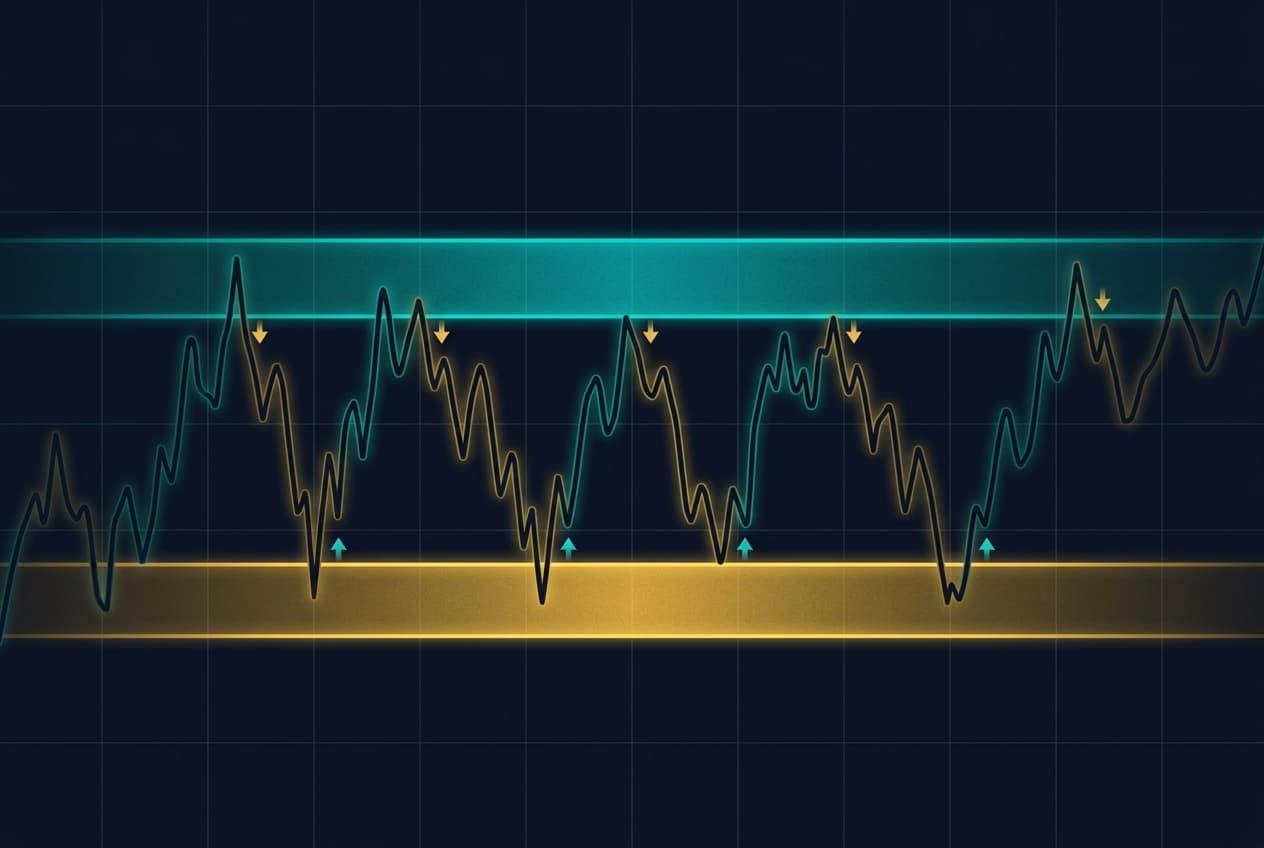
When price approaches a well-established support level, buyers tend to step in. When price approaches resistance, sellers tend to appear. These reactions create the small, predictable price bounces that scalpers rely on. Without a clear level to trade from, a scalper is just guessing, and guessing with small targets and tight stops is a recipe for rapid account depletion.
The best scalp trades happen at levels that are visible to many participants. The previous day's high and low, the pre-market high and low, round numbers (like $50, $100, $200), the opening price of the session, and the volume-weighted average price (VWAP) are all levels that institutional and retail traders reference. When price reaches one of these levels, the combined interest of many participants creates the reaction that makes the scalp work.
Identifying Key Intraday Levels
Before the trading session begins, mark these levels on your chart:
Previous day high and low. These are the most widely watched intraday levels. The previous day's high acts as resistance on the approach from below and as support once broken. The previous day's low acts as support on the approach from above and as resistance once broken.
Pre-market high and low. During the pre-market session, early participants establish a range. These boundaries often act as magnets and reaction points once the regular session opens.
Opening range. The high and low of the first 15 to 30 minutes of the session form the opening range. Breakouts beyond this range often lead to directional moves, while failures at the range boundaries are scalp opportunities.
VWAP (Volume-Weighted Average Price). VWAP represents the average price at which shares have traded throughout the session, weighted by volume. Institutional traders use VWAP as a benchmark for execution quality. Price tends to gravitate toward VWAP during slow periods and react to it as a dynamic support or resistance level. Longs above VWAP, shorts below VWAP is a simple but effective filter.
Round numbers. Price levels ending in .00 (and to a lesser extent .50) attract attention and orders. A stock approaching $150.00 from $149.50 is more likely to encounter selling pressure at the round number than at $149.73. Round numbers are particularly useful as scalp targets and reaction zones.

Scalp Entry Strategies
Strategy 1: Bounce off Support
Wait for price to pull back to a predetermined support level. Watch for the price to touch or slightly pierce the level and then produce a bullish candle (a candle that closes above its open). Enter long on the close of that candle or on a break above its high.
Example: Stock is trading at $52.30. You have the previous day's low marked at $51.80. Price drops to $51.78, slightly piercing the level, and the 1-minute candle closes at $51.88 with a long lower wick (showing buyers stepped in). You enter long at $51.89 with a stop at $51.68 (below the candle's low) and a target of $52.10 (approximately a 1:1 risk-to-reward, which is acceptable for scalps given the high win rate of level bounces).
Strategy 2: Rejection at Resistance
Wait for price to rally into a predetermined resistance level. Watch for the price to touch or slightly pierce the level and then produce a bearish candle. Enter short on the close of that candle or on a break below its low.
Example: Stock is approaching the pre-market high at $64.50. The 1-minute candle pushes to $64.55 but closes at $64.38 with a long upper wick. You enter short at $64.37 with a stop at $64.58 and a target of $64.10.
Strategy 3: Breakout and Retest
When price breaks through a significant level, wait for it to pull back and retest that level from the other side. A broken resistance level that now holds as support on a retest is a high-probability scalp entry. A broken support level that now holds as resistance is a short entry.
Example: Stock breaks above resistance at $75.00 on heavy volume, pushing to $75.40. Price then pulls back to $75.05. If the $75.00 level holds (price does not close back below it on the retest), you enter long at $75.08 with a stop at $74.88 and a target of $75.40 (the prior high) or beyond.
This strategy has a lower frequency than bounces and rejections because genuine breakouts followed by clean retests do not happen constantly. But when they do, the success rate is typically the highest of the three strategies because the retest confirms that the breakout was genuine.
Stop-Loss Placement for Scalps
Scalp stops must be tight. A scalp targeting $0.20 of profit cannot use a $1.00 stop loss. The risk-to-reward ratio would be terrible and no win rate could overcome it.
For level bounce and rejection trades, place your stop just beyond the level you are trading from, plus a small buffer for noise. If support is at $51.80 and the candle's low was $51.78, a stop at $51.68 gives 10 cents of buffer below the lowest point. This keeps your risk tight while avoiding being stopped out by normal market noise around the level.
A general guideline: your stop should be 0.1% to 0.3% of the stock price beyond the level. On a $100 stock, that is $0.10 to $0.30 beyond the support or resistance. On a $50 stock, $0.05 to $0.15. Adjust based on the stock's typical intraday volatility. Highly volatile stocks need slightly wider stops; low-volatility stocks can use tighter ones.
Take-Profit Targets for Scalps
Scalp targets should be realistic. You are not looking for home runs. A 1:1 to 1:2 risk-to-reward ratio is standard for scalps, and that is acceptable because well-chosen levels produce win rates of 60% to 70%.
Target the next support or resistance level in the direction of your trade. If you are long from $51.89 and the next visible resistance is at $52.20, that is your target. If the next level is too far away for a reasonable risk-to-reward, scale out of the position: take half at 1:1 and move your stop to breakeven on the remainder.
Do not hold scalp trades hoping they will become swing trades. If the trade reaches your target, take the profit. If price stalls before reaching your target, tighten your stop or close the position. The next opportunity is minutes away.
Timeframes for Scalp Trading
Scalpers use multiple timeframes simultaneously, each serving a different purpose.
15-minute chart: This provides context. It shows the overall intraday trend, the key levels, and the bigger picture structure. Before taking a scalp trade, check the 15-minute chart to confirm you are not trading against the dominant intraday direction.
5-minute chart: This provides structure. It shows the intermediate swings within the session and helps you identify the zones where price is consolidating before the next move.
1-minute chart: This is your execution timeframe. It shows the candle-by-candle price action at the levels you have identified. Your entry triggers, stop adjustments, and exit signals come from this chart.
Using all three timeframes prevents the common mistake of getting tunnel vision on the 1-minute chart and taking trades that contradict the larger picture. A 1-minute bounce off support is much more reliable when the 15-minute chart shows an uptrend than when it shows a strong downtrend that is likely to break through that support.
Risk Management for Scalpers
Scalping amplifies both the benefits and the dangers of position sizing. Because you take many trades, small mistakes compound quickly.
Position size: Calculate your position based on the distance from entry to stop, not on a fixed share count. If your risk per trade is $50 and your stop is $0.20 from your entry, your position size is 250 shares. If the stop is $0.10, the position is 500 shares. The risk in dollars stays constant; the share count adjusts.
Daily loss limit: Set a hard daily loss limit and honor it. For scalpers, 1% to 2% of account equity is reasonable. On a $25,000 account, your daily loss limit might be $250 to $500. Once you hit it, shut down for the day. No exceptions.
Transaction costs matter. Scalpers make more trades than any other style, which means commissions and fees accumulate. Make sure your broker offers competitive per-share or per-trade pricing. If you are paying $5 per trade and making 40 trades per day, that is $200 in commissions alone. Your scalping edge must be large enough to cover these costs and still produce a profit.
Track your statistics. Scalping generates enough data within a single week to identify whether your edge is real. Track your win rate, average win, average loss, and profit factor (gross wins divided by gross losses). A profit factor below 1.3 on a sample of 100+ trades suggests your edge is marginal and may not survive after accounting for slippage and commissions.
Tools and Indicators That Help Scalpers
Level 2 / Order Book: Shows the pending buy and sell orders at each price level. This reveals where large orders are sitting, which levels have the most interest, and whether the buying or selling pressure is dominant at the current price. Not essential, but helpful for timing entries at key levels.
Time and Sales (Tape): Shows every executed trade in real time. Experienced scalpers read the tape to detect whether large players are buying or selling at a particular level. A sudden burst of large buy orders hitting the ask at support confirms that buyers are defending the level.
VWAP: As mentioned earlier, VWAP acts as a dynamic intraday support and resistance level and helps you stay on the right side of institutional flow.
Volume bars: Simply watching whether volume increases or decreases at your levels confirms the validity of the reaction. A bounce off support on high volume is far more reliable than one on minimal volume.
Keep your chart clean. Scalping requires fast decision-making, and a cluttered chart slows you down. Price, volume, VWAP, and your predetermined levels are sufficient for most scalp strategies.
How PatternPilotAI Supports Scalp Trading
PatternPilotAI's rapid chart analysis can complement your scalp trading by providing an objective assessment of chart patterns forming on intraday timeframes. When you spot a potential setup at a key level, uploading the chart gives you a second opinion on the pattern's validity, the relevant support and resistance zones, and the position sizing implications based on the pattern's measured move.
The AI evaluation removes the emotional bias that builds up during fast-paced scalping sessions. After a string of losses, your judgment can become clouded. An objective pattern assessment helps you determine whether the next setup is genuinely strong or whether you are forcing a trade out of frustration.
Sign up for free and start using PatternPilotAI to verify your scalp setups before committing capital.
Ready to analyze your charts?
Try PatternPilotAI free. Upload any chart and get an AI-powered trade plan in seconds.
Get Started Free